Kawagoe: The Edo Street That a Fire Built
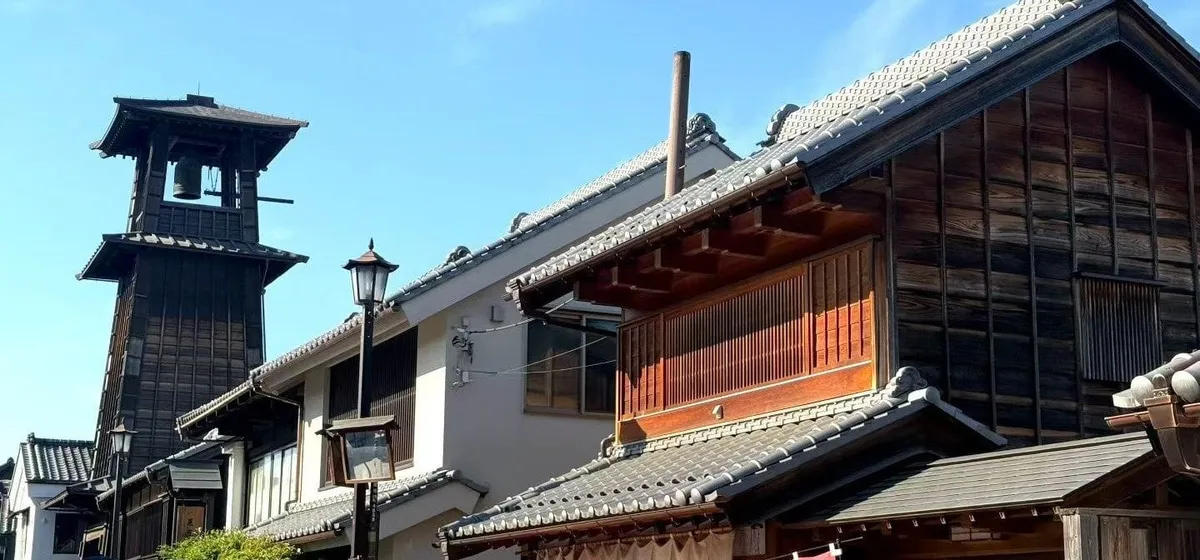
Fifty minutes north of Shinjuku, a street of black-plastered merchant houses stands under heavy tiled roofs, and a wooden bell tower rises above them. It is called Koedo — “Little Edo” — and the usual thing to say is that Kawagoe preserves the Edo period after Tokyo lost it.
That is true, and it is also not quite the story. Because most of what you are looking at was built in the 1890s, and the reason it exists is a fire.
The Fire of 1893
On the evening of 17 March 1893, a fire began in Kawagoe and the wind carried it. By morning it had taken seventeen blocks and 1,302 buildings — roughly a third of the town.
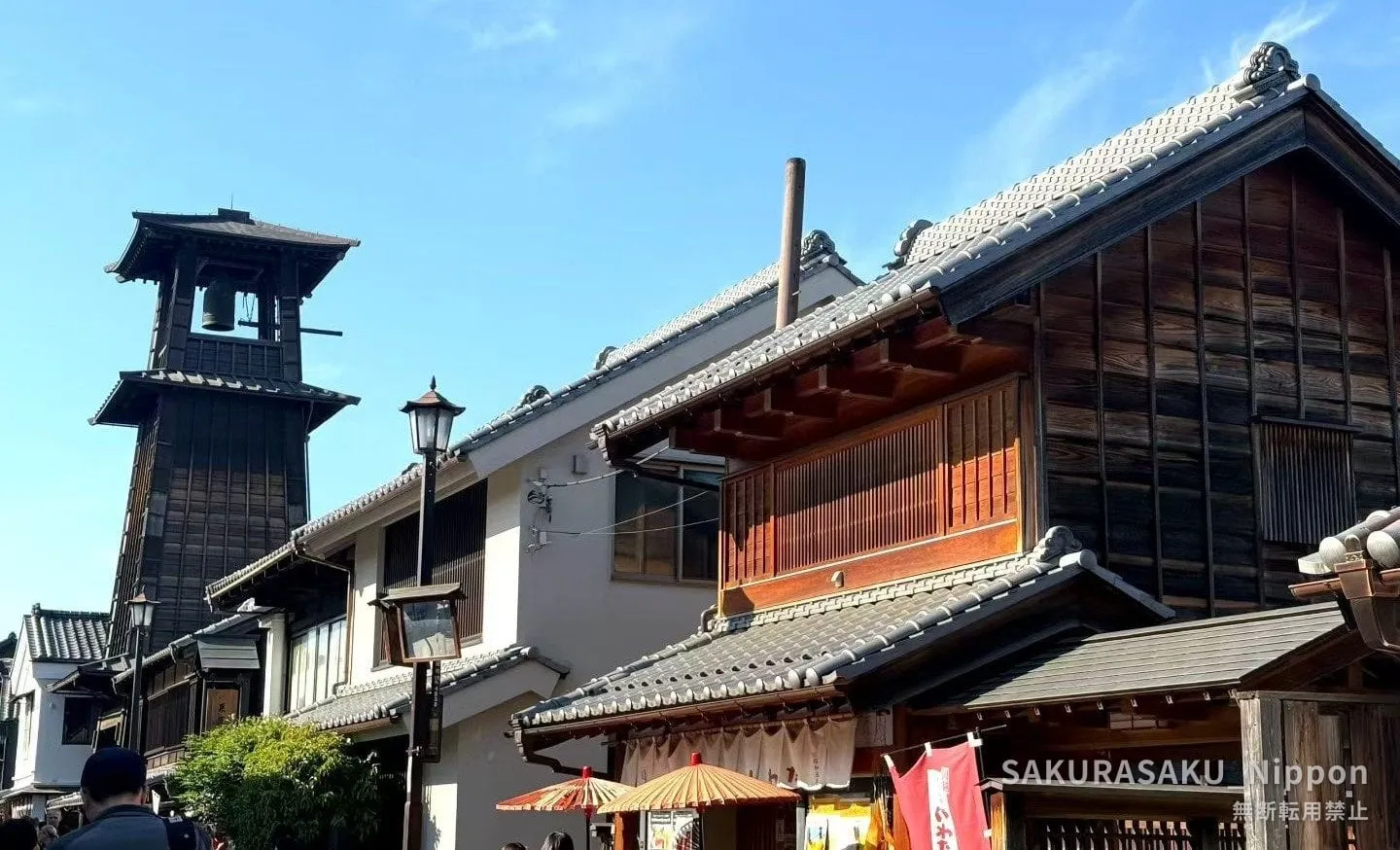
Almost everything burned. What did not burn were the kura: thick-walled, clay-and-plaster fireproof warehouses, of a type that Edo merchants had developed precisely for nights like that one. One of the survivors, the Ōsawa House, had been standing since 1792, and is still there today.
The merchants of Kawagoe drew the obvious conclusion. In the two or three years after the fire, more than two hundred kura went up along the main street — some built by craftsmen brought in from Tokyo — and that is the street you walk down now.
So when people say Kawagoe shows you the Edo townscape that Tokyo has lost, the precise version is stranger and better. These are Meiji-era buildings in an Edo form: what merchants built when they had just been frightened. The dignity of that street is a safety measure.
Kurazukuri Street
About thirty kura still stand along roughly 400 metres of Kurazukuri-dōri. The district was designated one of Japan’s Important Preservation Districts for Groups of Traditional Buildings in December 1999.
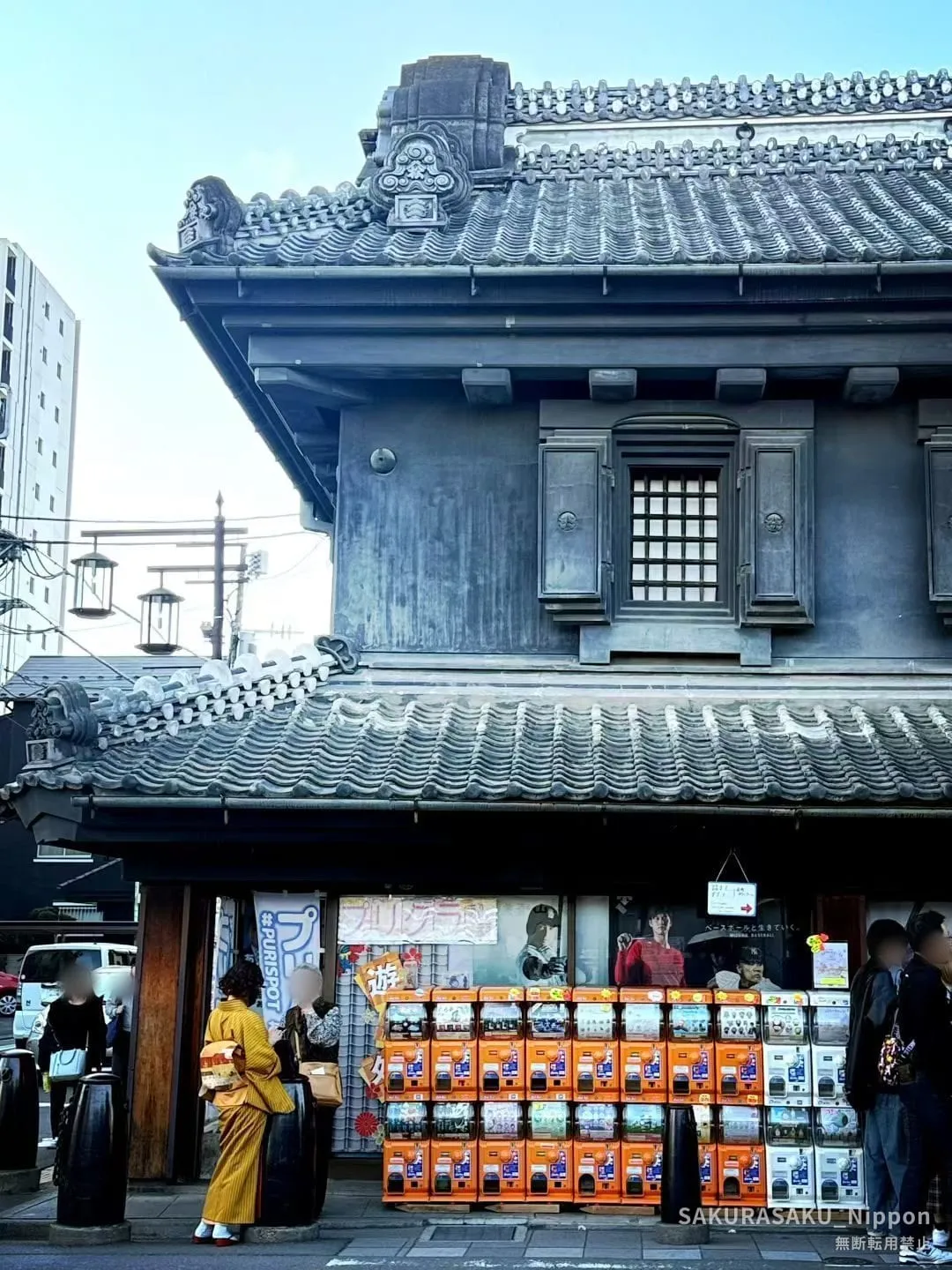
Look closely at the buildings and you will start to read them: the enormously thick eaves, the heavy ridge ornaments, the fitted shutters that could be sealed shut against sparks. Look at the ground floor and you will find capsule-toy machines, a photo-booth banner and a vending machine.
I would not have it otherwise. This is a working shopping street, not an open-air museum, and the shops in these buildings pay for their upkeep by selling things to people. Curated into silence, it would be handsomer and a good deal less alive.
Toki no Kane, and Two Kinds of Hundred
Above the rooftops stands Toki no Kane, the bell tower. The first one was put up by the lord of Kawagoe Castle, Sakai Tadakatsu, between 1627 and 1634. The tower you see is the fourth, rebuilt in 1894 — the year after the fire. It is three storeys and about 16 metres high.
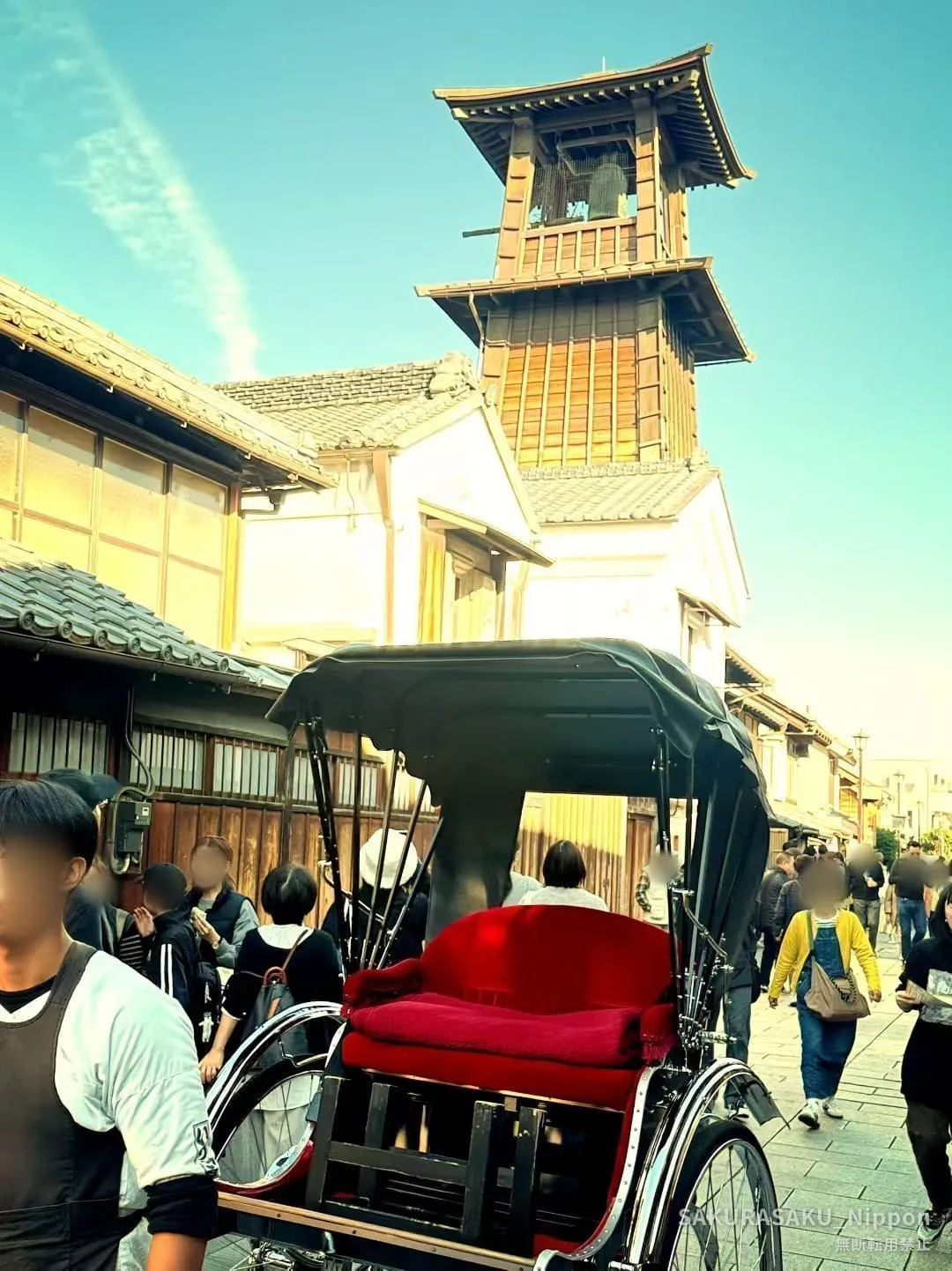
It still rings four times a day: 6 am, noon, 3 pm and 6 pm. In 1996 the Environment Agency put it on a list called “100 Soundscapes of Japan to be Preserved.”
Here is the honest footnote: the bell is struck by an automatic mechanism, not by a person. I mention it because I would rather you knew, and because it does not spoil anything. It is a real bell in a real tower, and at noon in a narrow street the sound arrives with weight.
Now the second hundred. Ten minutes away is Kashiya Yokochō, the confectioners’ lane, and it is on the Environment Ministry’s list of the “100 Best-Smelling Places in Japan.”
One town, two of those lists — sound and scent, ten minutes apart. It is a small thing, and I have not stopped thinking about it.
Kashiya Yokochō: A Lane Built by an Earthquake
The sweet-makers of Kawagoe have been here since the Meiji period, and the reason there were so many of them is, again, a disaster somewhere else.
When the Great Kantō Earthquake flattened much of Tokyo in 1923, the capital’s confectioners went with it — and Kawagoe took over, supplying chitose-ame, kintarō-ame, water-yōkan and karintō to the whole country. By the early Shōwa years there were more than seventy shops in this small area.
Today there are around twenty, on a stone-paved lane, several still making sweets by hand. Expect cinnamon candy, hand-pulled sweets, and fu-gashi — puffed wheat gluten coated in brown sugar, sold in sticks that can be nearly as long as a child is tall. You will pass someone carrying one. It is not a photo opportunity anyone has arranged.
An honest note: twenty shops is a lane, not a district. Fifteen minutes will see it, and it is at its best in the morning before the crowds and before the popular things sell out.
Kawagoe Hikawa Shrine, and Twenty Stones a Day
At the edge of the old town is Kawagoe Hikawa Shrine, said to be around 1,500 years old and the guardian shrine of the town. It is known throughout Japan for en-musubi — the tying of good relationships, romantic and otherwise.
Its most famous charm is worth explaining properly, because the mechanism is lovely.
A shrine maiden gathers gravel from the ground in front of the main hall, wraps it in a small linen net, and it is placed before the deity. These are the en-musubi-dama, and they are given out from 8 am, twenty per day, free of charge.
And they are on loan. If you find the person you spend your life with, you are asked to come back — the two of you together — and return the stone. In exchange you are given a different charm, one blessed for a bond that lasts.
I find that a genuinely beautiful piece of design. It costs nothing, it is deliberately scarce, and the transaction is only completed years later, by two people instead of one.
Also on the grounds: the great wooden torii, about 15 metres high and said to be the largest wooden torii in Japan. The calligraphy on its plaque was brushed by Katsu Kaishū, the statesman who negotiated the surrender of Edo Castle in 1868 — which is to say the man who ended the Edo period signed the gate of the shrine in the town that kept it.
A quiet request. This is an active shrine, not a monument. People come here to pray about their marriages, their families and their losses.
There is no admission charge, and the stones cost nothing either. That is worth understanding rather than simply enjoying: a shrine is not a business, and it is not selling you an experience. What it offers, it offers.
So please keep your voice down near the main hall, do not photograph people at prayer, follow any notices on the grounds, and if you queue for a stone at eight in the morning, remember that some of the people beside you are not sightseeing. Places like this stay open, and stay free, because visitors have treated them this way.
One thing to check before you plan around it: the shrine’s wind-chime display and its other seasonal events run only at certain times of year, and dates are announced annually. Do not travel for the wind chimes without checking the shrine’s own announcements first.
When to Go — and One Weekend to Avoid, or Aim For
The shrine’s festival, the Kawagoe Matsuri, is held on the third Saturday and Sunday of October. Floats of the Edo type — two-tiered, with a large figure raised on a central pillar — are pulled through these same streets by the old neighbourhoods of the town.
It was designated an Important Intangible Folk Cultural Property in 2005, and in 2016 it was inscribed on the UNESCO Intangible Cultural Heritage list as part of the Yama, Hoko, Yatai float festivals of Japan.
Which means that weekend is either the best possible time to come or the worst, depending entirely on what you want. The town is extraordinary and the town is full. Choose deliberately.
A Starbucks with a Garden Behind It
On Kanetsuki-dōri, a minute from the bell tower, is a Starbucks built in kurazukuri style — opened in March 2018, faced in Saitama-grown cedar and roofed in tile, and named by Starbucks itself as one of twenty of its stores worth visiting.
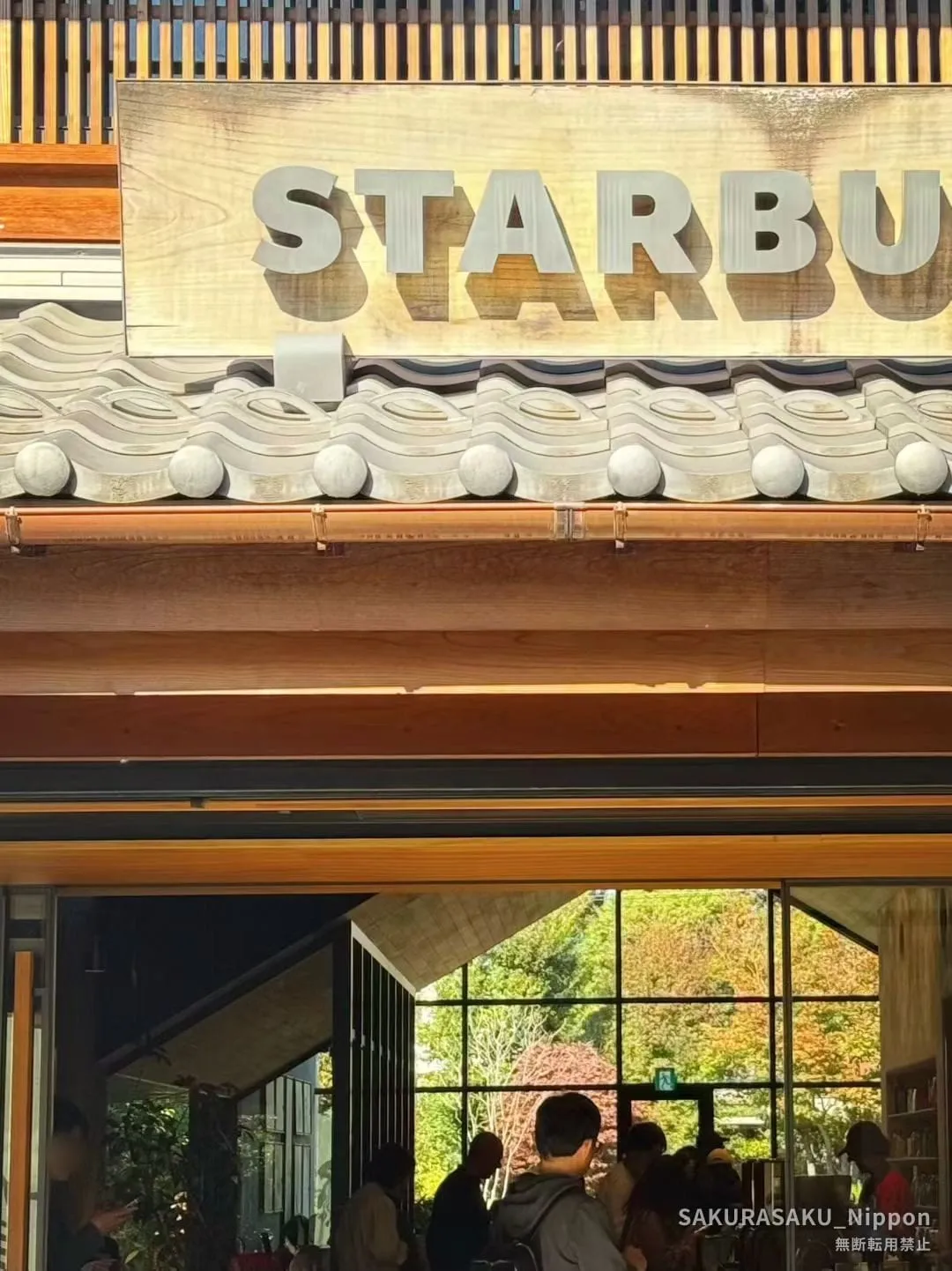
Most people photograph the front and walk on. Go inside and keep walking. There is a Japanese garden at the back, and terrace seating in it — of the 77 seats, 21 are out there. After a morning on a stone street in the sun, it is the best-value rest in Kawagoe.
The Small Things
Kawagoe still has the old round red postboxes — the cylindrical cast-iron design that has almost entirely disappeared from the rest of Japan.
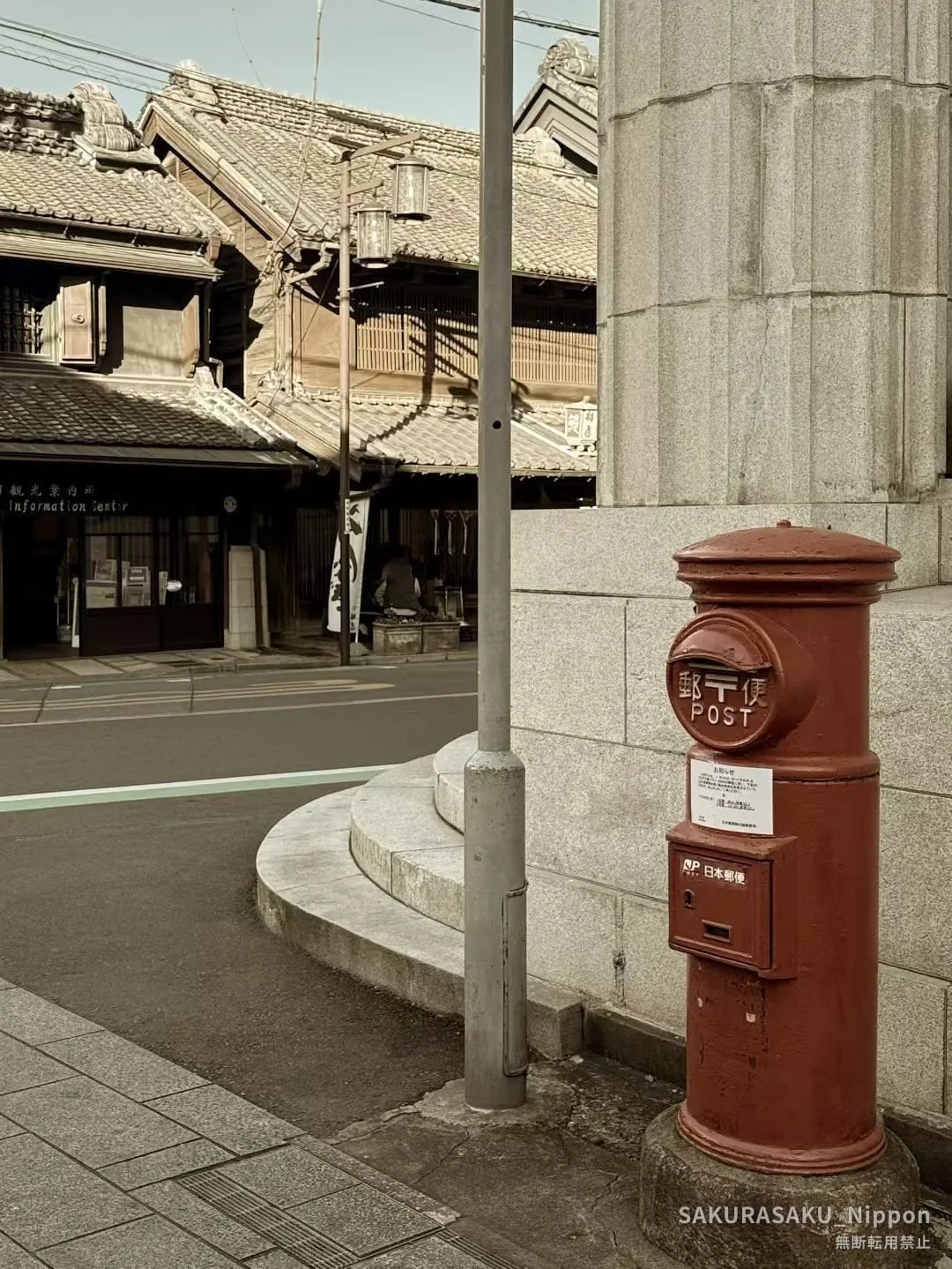
They are not decoration. The post is still collected from them, so you can send a letter home from one — which is a nicer souvenir than most things you can buy.
Getting There
From Seibu-Shinjuku Station: the Limited Express “Koedo” runs direct to Hon-Kawagoe, about 47 minutes. You need a normal fare (around ¥503 with an IC card) plus a limited express ticket (around ¥500) — so roughly ¥1,000, with a reserved seat. Ordinary trains on the same line are cheaper and take longer.
Other routes: the Tōbu Tōjō Line from Ikebukuro and the JR Kawagoe Line both reach Kawagoe Station. If you are staying near Ikebukuro rather than Shinjuku, take the Tōbu.
Discount round-trip passes exist for both the Seibu and Tōbu routes, some of them bundling unlimited local buses — worth a look if you are coming from Tokyo for the day.
A note for anyone who likes trains. The Limited Express Koedo currently runs with the 10000 series “New Red Arrow.” Seibu has announced that from spring 2027 these will be replaced by new “Tokiiro” trains and the service renamed. If you want to ride the Red Arrow to Little Edo, the window is closing.
A Half-Day That Works
The old town is compact and everything below is within a fifteen-minute walk of everything else.
- Hon-Kawagoe Station — about 15 minutes on foot to the bell tower
- Kashiya Yokochō first, while the shops are full
- Kurazukuri-dōri, slowly, looking up
- Toki no Kane — try to be nearby at noon or 3 pm
- Starbucks, and the garden at the back
- Kawagoe Hikawa Shrine to finish
If you want the en-musubi-dama, invert the whole thing and be at the shrine at 8 am.
Practical Information
- Where: Kurazukuri-dōri and the old town, Kawagoe, Saitama
- Nearest stations: Hon-Kawagoe (Seibu Shinjuku Line) · Kawagoe / Kawagoe-shi (Tōbu Tōjō Line, JR Kawagoe Line)
- From Shinjuku: about 47 minutes by Limited Express “Koedo”; roughly ¥1,000 including the express ticket
- Kurazukuri-dōri: open street, free
- Toki no Kane: free to view; rings 6:00, 12:00, 15:00, 18:00
- Kashiya Yokochō: around 20 shops, generally daytime hours, individual shops vary
- Kawagoe Hikawa Shrine: grounds free; en-musubi-dama from 8 am, 20 per day, free
- Kawagoe Matsuri: third Saturday and Sunday of October
- Allow: half a day; a full day if you include the shrine and lunch
Taking Kawagoe Home
If the buildings are what stayed with you, there is a book for exactly that.
Kawagoe no Tatemono: Kurazukuri-hen (『川越の建物 蔵造り編』, Semba Shobō, 2022) takes eighteen of these kura one at a time and gives each its history, its details, and a photograph of how it used to look beside how it looks now. It is 158 pages, A5, put together by the Kawagoe no Tatemono editorial committee, with illustrations by the animation studio feel.
Please know before you buy: the text is entirely in Japanese. What survives translation is the photographs, the illustrations, and the then-and-now pairs — and if you have walked the street, those are legible on their own. It is the second in a series; the first covers Kawagoe’s Western-style modern architecture.

Eighteen kura, one at a time — with then-and-now photographs
View the Kawagoe kura architecture book on Amazon.jp
View the book on Rakuten Books (Japanese-language site)
This one ships outside Japan. Amazon.jp will send it overseas; the international postage is shown at checkout, and your own country may add customs charges.
Price and stock may change (¥2,200 including tax at the time of writing).
Two practical notes: Amazon Japan and Rakuten can both deliver to your hotel during your stay, but please check with the hotel first that they accept parcels for guests. And on Amazon.co.jp, the English display toggle is at the top right of the screen.
→ More on this book in a separate article.
Walking It in a Kimono
A great many people here are in kimono, and almost none of them own one. Rental shops dress you, do your hair, and let you spend the whole day in it — Kimono Rental Wargo is three minutes from Hon-Kawagoe Station, with kimono, obi, bag and sandals included, from around US$28.
Two honest points. There are few better backgrounds in the Tokyo area for photographs of yourself in kimono than this street — that is simply true. But geta on a stone road for six hours is a real decision, and there is an option to return the outfit the following day, which is worth taking if you are staying nearby.

If you would rather not work out the trains at all, there are coach day tours from Tokyo that take in Kawagoe alongside other stops.
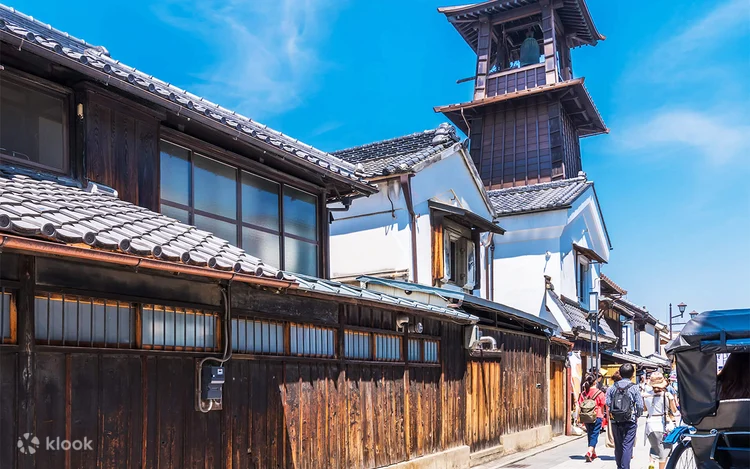
And if you would like the town early in the morning or after the day-trippers leave — which is when Kurazukuri-dōri is at its best — staying the night is the way to get it.
While You Are on the Seibu Shinjuku Line
Kawagoe is the far end of the same line that runs through the quiet western suburbs of Tokyo, and there are two stops on it worth knowing about.
Kami-Igusa Station is where trains halt at a level crossing an arm’s length away, with a bronze Gundam at the south exit — the best place on this line to photograph a train. And if the Red Arrow has caught your interest, a Japanese railway mook devoted to Seibu includes a guide to trackside photo spots along it.
Who Is This For?
Anyone in Tokyo with a spare day who wants an old town that is genuinely still a town. Anyone who likes a place better once they know why it looks the way it does. And anyone who thinks that a shrine giving away twenty stones a morning, on the condition that you come back with somebody, is a good idea — which it is.
Note: Train times and fares, shop hours, festival dates and shrine events all change. Please check current timetables and the shrine’s own announcements before you travel.
Affiliate note: This article contains Amazon, Rakuten and Klook affiliate links. As an affiliate, we may earn from qualifying purchases at no extra cost to you.