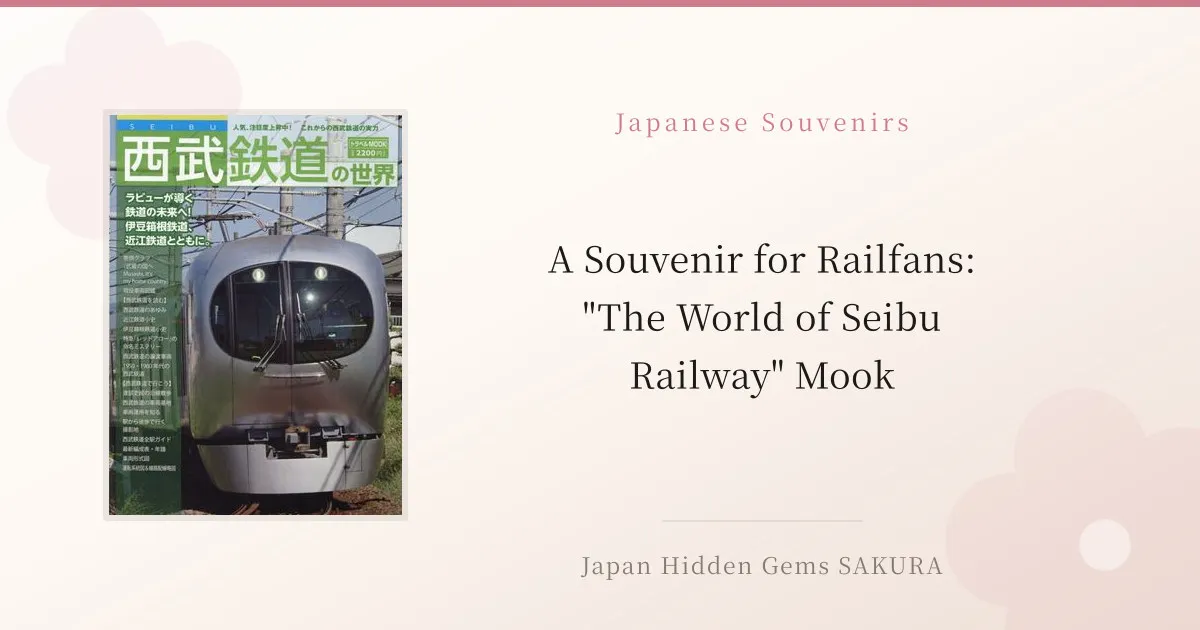
A Souvenir for Railfans: "The World of Seibu Railway" Mook
If you have spent an afternoon at a level crossing in Tokyo, watching the trains come and go, you may already know the feeling: you would like to keep a little of it. Not a keychain, and not a plastic model — something that lets you look at those trains again, slowly, after you are home.
For that, there is a very Japanese answer: the railway mook.
What a “Mook” Is
A mook is a magazine-sized book — thicker and more generous than a magazine, softer and less formal than a proper hardback. Japan produces wonderful ones about railways, and the one I would like to introduce is “The World of Seibu Railway” (西武鉄道の世界), published by Kotsu Shimbunsha and edited by the team behind Tetsudo Diamond Joho, one of Japan’s long-running railway magazines.
It was published in July 2025, in a large A4-variant format, at around ¥2,200 including tax at the time of writing.
What Is Inside
This is the part that makes it worth carrying home. The book covers Seibu Railway as it is today:
- A full fleet directory — the current rolling stock in photographs, including the striking Laview limited express, and the “sustainable” trains that came to Seibu second-hand from the Odakyu line
- Two sister railways as well — the fleets of the Ohmi Railway and the Izuhakone Railway, both part of the wider Seibu group
- Route diagrams and station information for the whole network
- A guide to trackside photography locations — where railfans actually stand to take their pictures
- History and small mysteries — a short history of the line, and an essay on how the “Red Arrow” limited express got its name
That photography guide is the reason I mention this book here at all. If you enjoyed standing at the crossing and watching the trains arrive, this is the book that tells you where else in the Seibu network people go to do exactly that.
→ Related: Kami-Igusa Station: a quiet railfan crossing in west Tokyo
One Honest Warning
The text is entirely in Japanese. There is no English edition, and I would rather tell you plainly than have you feel disappointed when it arrives.
That said, a great deal of this particular book does not depend on the language at all. The fleet directory is photograph after photograph of trains; the route diagrams, formation tables, and photo-spot maps are visual; and the numbers, station names, and train type names appear in a form you can follow. Many railfans abroad collect Japanese railway books for exactly this reason. If you want something to read, this is not the book. If you want something to look at — and to identify what you photographed — it is a lovely one.
Why It Travels Well
- It is flat and light — it slides into a suitcase beside your clothes, with no risk of breaking
- It is genuinely hard to find outside Japan — this is not a book you can casually order at home
- It is inexpensive for what it is — around ¥2,200, less than a nice lunch in Tokyo
- It stays interesting — a photo book is something you open again years later
Price and Where to Buy

"The World of Seibu Railway" (西武鉄道の世界), Kotsu Shimbunsha
View The World of Seibu Railway on Amazon.jp
View The World of Seibu Railway on Rakuten Books (Japanese site)
This one ships outside Japan. Amazon.jp will send it overseas; the international postage is shown at checkout, and your own country may add customs charges.
Price and stock may change (around ¥2,200 including tax at the time of writing)
You can also find railway mooks in person, in the large bookshops of Tokyo — the railway shelves at Kinokuniya in Shinjuku, Maruzen in Marunouchi, or the bookshops inside the larger stations. Browsing them is a pleasure in itself, even if you cannot read a word.
How to Have It Delivered to Your Tokyo Hotel
Amazon Japan and Rakuten can both deliver your order directly to the hotel where you are staying. Ordering a few days before your flight home works well — you can simply receive the package at the front desk. When you order, please set the shipping address to your hotel, and add the hotel name and your guest name as it appears on the reservation.
- Please check with your hotel in advance that they accept packages for guests
- On Amazon.co.jp, the English display toggle is at the top right of the screen. Rakuten is a Japanese-language site, so your browser’s translation feature is the easy way through
Where to Use It
The book’s trackside photo guide covers the Seibu network, and two stops on the Shinjuku Line are the easiest places to put it to work: Kami-Igusa, where trains halt at a level crossing an arm’s length away, and the far end of the same line at Kawagoe — reached by the Limited Express “Koedo,” still running the 10000 series New Red Arrow until its replacement from spring 2027.
Who Is This For?
Anyone who found themselves photographing trains in Japan and enjoyed it more than they expected. It is also a kind gift for a railway-loving friend at home, who will almost certainly not own it — and who will spend a happy hour working out what each train is.
Affiliate note: This article contains Amazon and Rakuten affiliate links. As an Amazon Associate, we earn from qualifying purchases at no extra cost to you.