Kawagoe's Kura, One Building at a Time
Walk Kawagoe’s warehouse street for twenty minutes and a small problem sets in. Every building is black, heavy and handsome — and after a while, they all start to look the same.
Each one has a name, a date, and a story about surviving the fire. Almost none of that is on a sign, and none of it is in English.
There is a book that takes on exactly that problem.
The Book
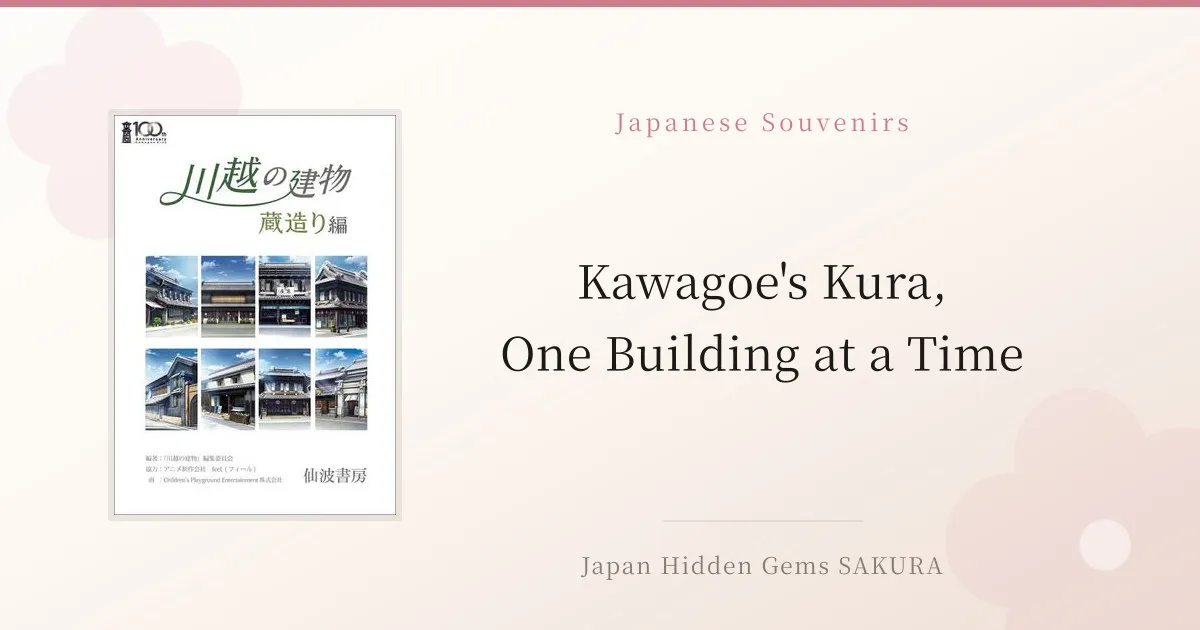
Kawagoe no Tatemono: Kurazukuri-hen (『川越の建物 蔵造り編』), compiled by the Kawagoe no Tatemono editorial committee and published by Semba Shobō. It came out on 30 September 2022: A5 format, 158 pages, full colour, at ¥2,200 including tax.
It is the second in a series — the first covered Kawagoe’s modern Western-style architecture — and this volume takes eighteen of the town’s kura, the thick-walled merchant storehouses that double as shopfronts.
What Is Inside
Each building gets the same treatment:
- An outline and a history — when it was built, whose shop it was
- The details explained — the roof, the ridge-end tiles, the heavy hinged shutters
- An old photograph beside a current one — the same building, then and now
The then-and-now pairing is the part that does the work. Seeing that the building in front of you was standing in the same spot a century ago changes how the street reads.
The book is also full of illustrations, produced with the help of the animation studio feel. The publisher’s own phrase for them is that they are drawings that make you want to go and see the real thing.
→ Related: Kawagoe: The Edo Street That a Fire Built
It Is Made by One Person
What makes this book unusual is the publisher.
According to an interview in the Tokyo Shimbun, Riichi Kamiya, who runs Semba Shobō, grew up in Semba-chō in Kawagoe and does everything himself — the photography, the writing, the sales, even the accounts. He is what Japan calls a hitori shuppansha, a one-person publishing house. Before this, he worked for the post office, where he once had a postbox installed that suited the look of the old town.
On why he used animation-style artwork, he said: “The clear blue sky and the shadows on the buildings — that was something only animation art could achieve.”
And on the book itself: “I would be happy if people went sightseeing in Kawagoe with this in hand.”
It looks like a guidebook, but it is not one. It is a book about one town’s buildings, researched and written by someone from that town — which is a different object from the guides on the shelf at the station.
Why It Travels Well
- A5 and slim — it slides into a suitcase, and 158 pages is not heavy
- Effectively unavailable outside Japan — a one-person publisher’s book does not reach foreign bookshops
- It works after the trip — open it at home and the buildings you walked past acquire names
- ¥2,200 — less than the eel lunch you probably had in Kawagoe
One Honest Warning
The text is in Japanese only. There is no English edition and no English summary.
That said, this is a book where the photographs and illustrations carry most of the meaning, and the then-and-now comparisons need no translation at all. If you are learning Japanese, or if you mainly want to look at the buildings, it holds up. As a gift for someone who does not read Japanese, go in knowing that.
Price and Where to Buy

Kawagoe no Tatemono: Kurazukuri-hen (Semba Shobō, text in Japanese)
View the Kawagoe kura architecture book on Amazon.jp
View the book on Rakuten Books (Japanese-language site)
This one ships outside Japan. Amazon.jp will send it overseas; the international postage is shown at checkout, and your own country may add customs charges.
Price and stock may change (¥2,200 including tax at the time of writing).
The ISBN is 978-4-910500-01-0. Bookshops in Kawagoe and some of the town’s visitor facilities stock it too — buying it there, on the day, is the nicest way to do it.
How to Have It Delivered to Your Tokyo Hotel
Amazon Japan and Rakuten can both deliver your order directly to the hotel where you are staying. Ordering a few days before your flight home works well — you can simply receive the package at the front desk. When you order, please set the shipping address to your hotel, and add the hotel name and your guest name as it appears on the reservation.
- Please check with your hotel in advance that they accept packages for guests
- On Amazon.co.jp, the English display toggle is at the top right of the screen. Rakuten is a Japanese-language site, so your browser’s translation feature is the easy way through
When to Open It
Honestly: after the trip works better than before it.
Read it first and you end up hunting for eighteen specific buildings, which turns a walk into a checklist. Walk the street knowing nothing, come away with a memory of black tile and heavy shutters, and then open the book — and each of those memories quietly acquires a name.
Who Is This For?
Anyone who walked Kawagoe and found the buildings more interesting than expected. And anyone who would like to stop merely looking at old Japanese streets and start reading them — eighteen buildings is enough to learn the vocabulary, and it transfers to every other old town in Japan.
Affiliate note: This article contains Amazon and Rakuten affiliate links. As an Amazon Associate, we earn from qualifying purchases at no extra cost to you.