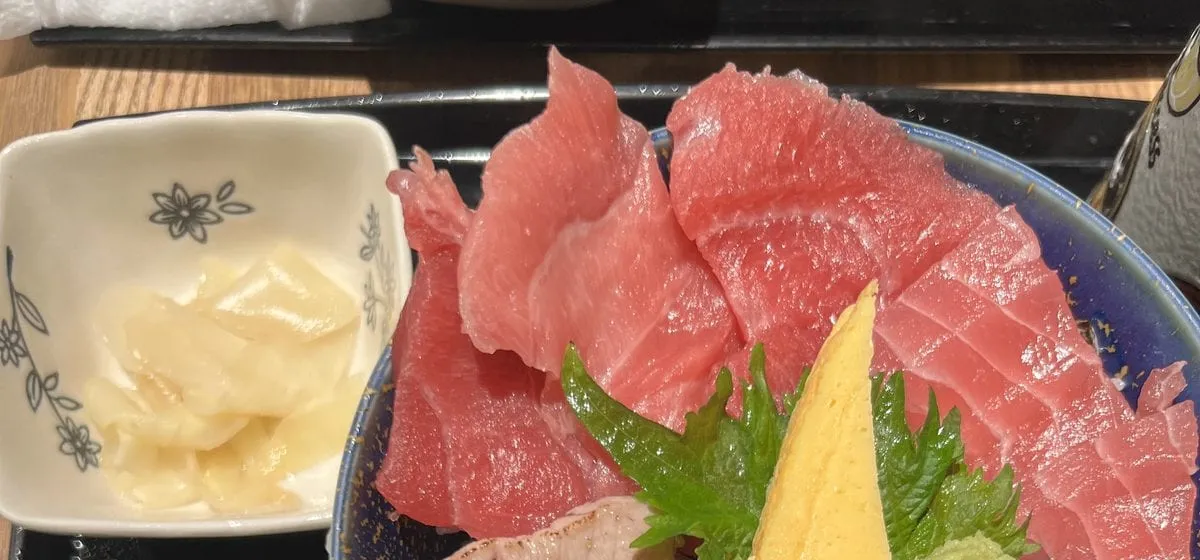
Breakfast at Toyosu Market: What to Eat, and What to Skip
It is half past six in the morning, you have just watched a thousand tuna change hands, and you are extremely hungry. This is the correct order of events.
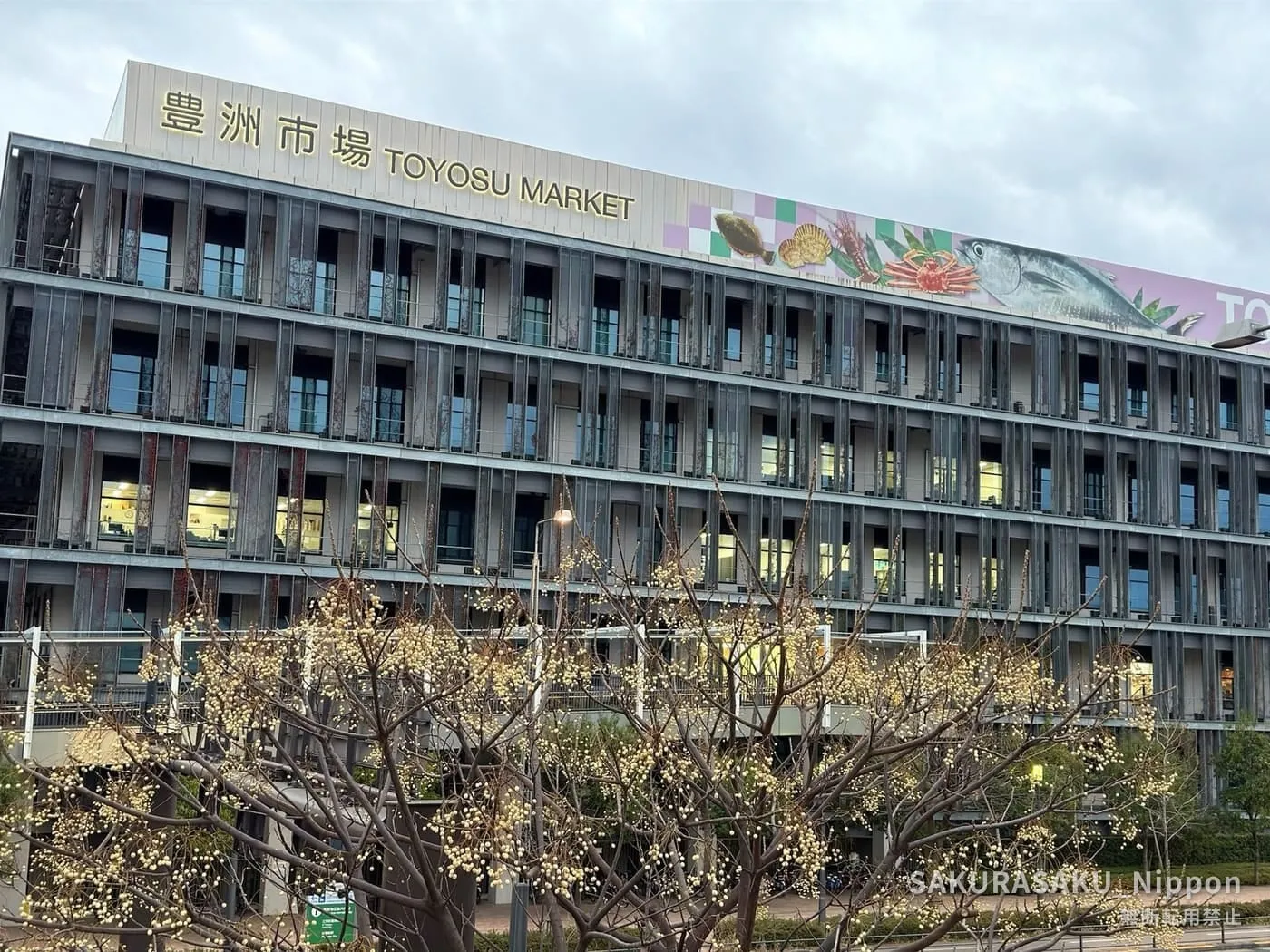
Toyosu Market has restaurant floors that open before dawn and a shopping arcade full of things professional cooks come here to buy. It is a genuinely good breakfast. But I would like to set your expectations honestly first, because a lot of visitors arrive imagining something Toyosu is not.
First, an Honest Warning
Toyosu is not Tsukiji Outer Market. If you have seen photographs of people eating grilled scallops on a stick in a narrow lane, wandering from stall to stall with something in each hand — that is Tsukiji, thirty minutes away, and it still exists.
Toyosu is a modern facility built for a wholesale market. The restaurants are proper sit-down restaurants along a clean indoor corridor. There is no street food, no strolling and grazing, and eating in the corridors is not permitted anywhere in the market. It is a good breakfast, but it is a breakfast, not a food crawl.
The other thing worth saying plainly: some of the restaurants here are aimed squarely at visitors, and not every one of them offers value that we as Japanese diners would consider fair. Prices at the market are not automatically low, and quality is not automatically high. Please choose with your eyes open.
The One Thing I Would Not Order
Do not order the sea urchin at the tourist-facing shops.
I ate it, at a restaurant of exactly that kind. It was dark brown rather than the clear orange of good Japanese uni, and it was bitter. I do not believe it was domestic uni of any quality.
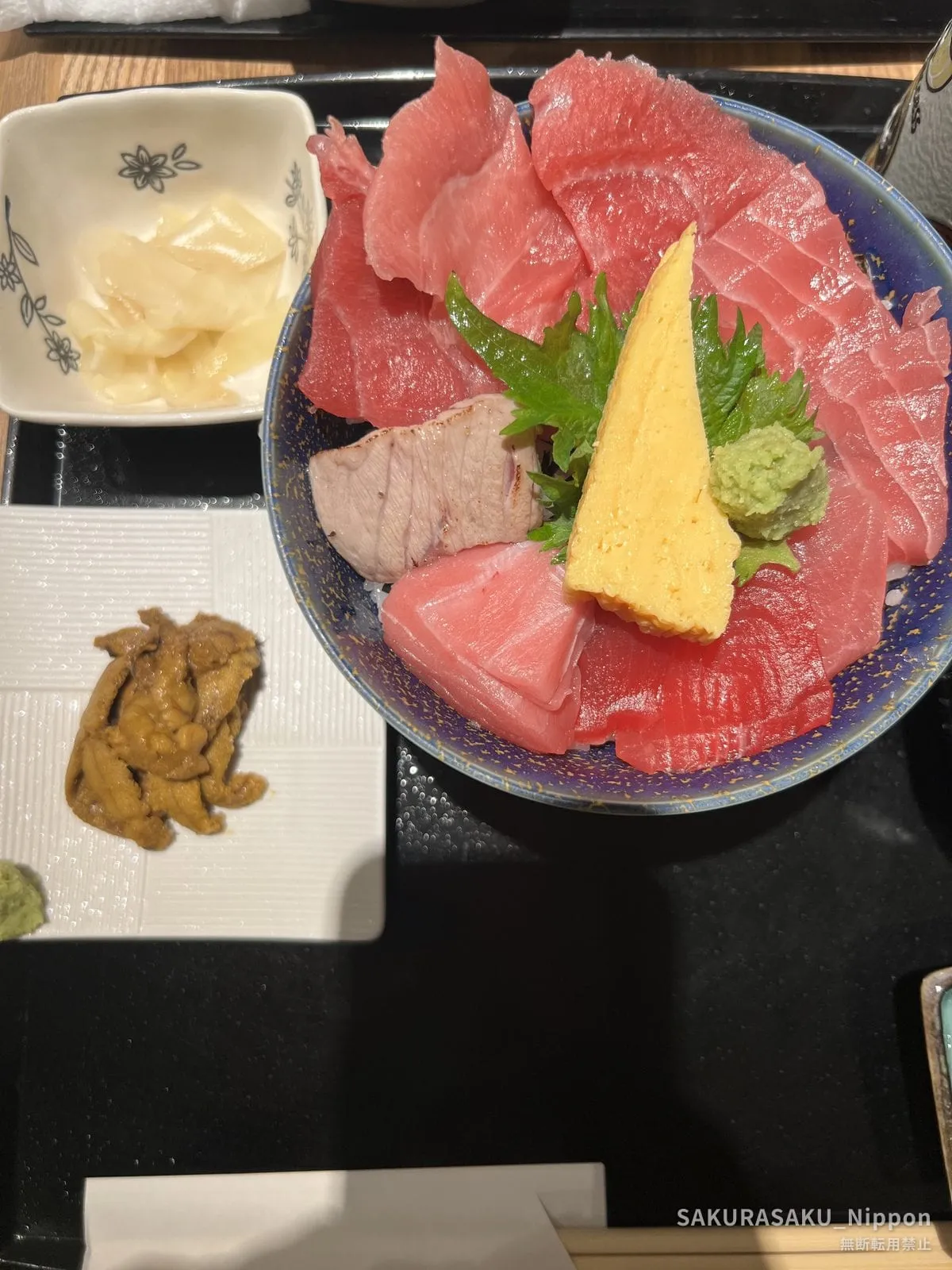
Uni is the single most expensive ingredient on a market menu and the easiest place to cut a corner, because most visitors have nothing to compare it against. If you want to try excellent Japanese uni, do it at a sushi counter that specialises in it, and expect to pay for it properly. Tuna, on the other hand, is exactly what you came for — it is the market’s own product, it is fresh, and it is hard to get wrong.
Where the Restaurants Are
They are in three separate places, which surprises people. Look for “Restaurants Area” on the map.
| Block | Floor | Notes |
|---|---|---|
| Block 6 (Fisheries Intermediate Wholesale) | 3F | The largest cluster |
| Block 7 (Fisheries Wholesale / Management Building) | 3F | Nearest the tuna auction and the PR Corner |
| Block 5 (Fruit and Vegetable) | 1F | Quietest of the three |
If you have just come from the auction, Block 7 is the one you are standing in.
Opening hours run from very early to around lunchtime. Some places close well before noon. Do not plan a 1pm lunch at Toyosu — plan breakfast, and treat anything after 11am as a gamble.
Queues at the best-known sushi restaurants form before the market opens. If a particular restaurant matters to you, be in the line early; if it does not, walk on and try the one with no line. The fish came off the same floor.
Uogashi Yokocho: The Part Most Visitors Miss
On the 4th floor of Block 6 is Uogashi Yokocho, an arcade of specialist shops that moved here from Tsukiji. This is where chefs shop, and — this is the good part — members of the public are welcome to buy too.
What is here: professional kitchen knives, dried bonito and kombu for stock, wasabi, pickles, nori, tea, tableware, sushi-shop supplies of every kind. The knife shops in particular are worth the visit on their own.
Before you go up, a few practical things:
- Bring cash. Most shops are cash-only; a few take cards or e-money
- Prices are fixed. There is no haggling here — it is not that sort of market
- Everything closes around midday, and some shops much earlier
- No eating or drinking inside the arcade
- Early morning is crowded with trade buyers, and carts and turret trucks use the same corridors. Watch your step and keep out of the traffic
- No lockers, no pushchair parking, no pets
- Bring a cool bag if you are buying anything chilled
If you would like to know what to do with what you buy: I have written about Kayanoya dashi stock packets, which are the easiest way to take Japanese flavour home, and about Japanese kitchen shears — both are the sort of thing the shops up here sell in professional versions.
Toyosu Senkyaku Banrai — and Why It Cannot Help You at Dawn
Next to the market stands Toyosu Senkyaku Banrai, a purpose-built dining and hot-spring complex with an Edo-style shopping street. It looks, in photographs, exactly like the lively market food scene visitors are hoping for.
Its restaurants open at 10:00 — a handful of second-floor shops from 9:00, and the foot-bath garden from 9:00 as well.
So if you have come for the auction, it is closed while you are hungry and open long after you have gone. That is not a criticism of the place — it simply serves a different visitor, arriving at a different hour. If you would like to see it, come back later in the day, or plan a second, lazier visit. The hot spring on the upper floors runs around the clock.
What to Buy, and What to Know Before You Do
The intermediate wholesale floor is closed to sightseers and guarded — only trade buyers may enter, and they buy in quantities a household has no use for. Uogashi Yokocho on the 4th floor is the part that is open to everyone, and it is where you should do your shopping.
Fresh fish to take back to a hotel room is, realistically, not practical. Dried goods, knives, tea and tableware travel much better, and are what most visitors end up glad they bought.
Practical Info
- Name: Toyosu Market restaurant and shopping areas
- Address: 6-6-1 Toyosu, Kōtō, Tokyo
- Nearest station: Shijo-mae Station, Yurikamome Line
- Restaurants: Block 6 (3F), Block 7 (3F), Block 5 (1F) — early morning to around midday
- Uogashi Yokocho shops: Block 6, 4F — early morning to around midday, mostly cash
- Toyosu Senkyaku Banrai: Shops 10:00–18:00, restaurants 10:00–22:00 (a few second-floor shops from 9:00; foot-bath garden 9:00–22:00; hot spring 24 hours)
- Closed: Sundays, public holidays, and most Wednesdays — check the market calendar
- Budget: A tuna bowl is roughly ¥2,500–5,000 at the time of writing, depending on the cut and the shop
Before You Sit Down
One last thing. The restaurants and shops here exist mainly to feed and supply the people who work in the market — the drivers, the buyers, the cutters, who have been awake since two in the morning. You are welcome, genuinely. But at seven in the morning the person at the next seat may be halfway through a working day.
Eat well, keep your voice down, do not spread out across a small counter, and give way in the corridors to anyone pushing a cart. It costs nothing and it is the reason places like this stay open to visitors at all.
If You Have Not Been to the Auction Yet
Breakfast is the second half of the morning. The first half is the tuna auction, and how the free lottery works — worth reading before you plan the day, because the application closes a month ahead.
After Eating It, Try Making It
A morning of very good sushi is a good day to learn how it is put together. There are classes in Tokyo where a professional chef takes you through it, and the fish you watched being handled on the market floor makes rather more sense in your own hands afterwards.
Tokyo: Sushi Making Class with a Professional Chef

If you would rather take longer over it — or if you do not eat fish — there is a three-hour class in Shinjuku that goes further into the groundwork. You make rolled omelette, sushi rice, inari, a tuna roll, a cucumber roll, a California roll and nigiri, along with miso soup, and then you sit down and eat all of it.
The useful part: vegetarian substitutions, and an alternative to the usual dashi stock, are available if you ask when you book. Not every sushi class will do that, and it is worth knowing if dashi is a problem for you — it is made with fish, and it turns up in almost everything.
Sushi Workshop in Tokyo — three hours in Shinjuku with a chef, in English, €66 per person
See the sushi workshop on Japan Experience →Note: Opening hours, prices and closing days change, and individual shops set their own hours. Please check before you travel.
Affiliate note: This post contains Klook and Japan Experience affiliate links.