Hida Shunkei Lacquer: The Japanese Bowl That Shows Its Own Wood Grain
Ask most travellers to picture Japanese lacquerware and they will describe something glossy, black, and slightly forbidding — the sort of object you admire in a museum case and would be nervous to eat from.
Hida Shunkei (飛騨春慶) is the gentle exception, and it is the one I would suggest bringing home.
Lacquer That Shows the Wood
Almost all lacquerware is opaque. Layers of black or vermilion are built up until the wood underneath disappears entirely, and the surface becomes a mirror.
Hida Shunkei works the other way round. The wood is prepared, lightly coloured, and then finished with a transparent lacquer — so instead of hiding the grain, the finish sinks into it and lifts it. What you get is a clear, warm amber surface with the pattern of the tree still running through it. No two pieces are quite alike, because no two boards are.
The technique was born in Takayama, in the mountains of Gifu, in the early 1600s, and it is still made there. It is one of Japan’s officially designated traditional crafts.
Why It Is Nice to Actually Own
Lacquer has practical virtues that are easy to miss:
- It is very light. Pick up a wooden lacquer bowl after a ceramic one and the difference is startling.
- It does not conduct heat. You can hold a bowl of hot soup comfortably in your hands — which is precisely why Japanese soup is served in one, and drunk from the bowl rather than spooned.
- It is warm to the touch, and quiet against a table.
- It is not fragile in a suitcase. Wood does not shatter. Of all the beautiful things you might carry home from Japan, this is among the least anxious.
The Maker
The bowl I would point you to is by Yamada Heiando (山田平安堂), a lacquer house founded in 1919 in Nihonbashi and now based in Daikanyama, Tokyo. It is known as a purveyor to the Imperial Household, and supplies the Ministry of Foreign Affairs and Japanese embassies overseas.
The piece is a 21 cm bowl — a genuinely useful size: salad, fruit, noodles, or simply left out on a table with nothing in it at all.
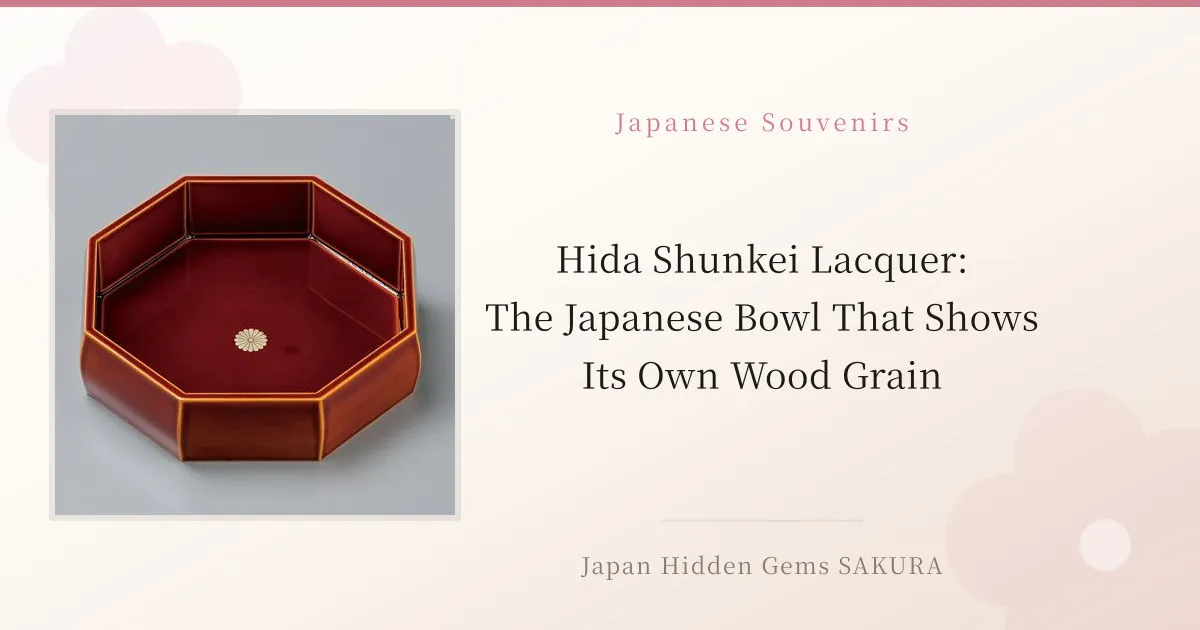
There is also a serving bowl in the same Shunkei lacquer: an eight-sided piece with a chrysanthemum crest, made by a workshop in Hida Takayama. It is usually sold as a commemorative gift for national decorations, which is why the crest is there — but it serves fruit or sweets perfectly well, and looks good on a shelf with nothing in it.

Eight-sided serving bowl with chrysanthemum crest, Hida Shunkei lacquer
View the eight-sided Hida Shunkei serving bowl on Rakuten (Japanese site))
Price, stock and dimensions are listed on the product page.
One Honest Warning
Lacquer asks for a little care, and you should know this before you buy rather than after.
- Wash it by hand, gently, with warm water and a soft cloth. Not the dishwasher.
- Keep it out of direct sunlight, and away from prolonged soaking.
- No microwave, no oven.
None of this is difficult — it is roughly the care a good wooden chopping board wants. But if your household runs entirely on the dishwasher, this is not the right gift, and I would rather say so now.
How to Have It Delivered to Your Tokyo Hotel
If you would rather not carry it around while you travel, Amazon.co.jp and Rakuten can both usually deliver to your hotel.
- Enter the hotel’s address in the delivery field, and your own name with the room number (for example, “Smith / Room 812”).
- Ask the hotel in advance. Most will hold a parcel for a guest, but not all of them do, and it is much better to know beforehand.
- On Amazon.co.jp the language switch is at the top right of the screen, which turns the whole site into English. Rakuten is Japanese-only, so your browser’s translation feature is the easy way through.
Where This Came From
We first went looking at Yamada Heiando’s work while writing about the New Year greeting at the Imperial Palace. The same house also makes the bonbonnière, the little Imperial sweet box — a lovely thing, though a keepsake rather than something you eat from.
Who Is This For?
Anyone who would like a souvenir that ends up in daily use rather than on a shelf. It is light, it travels well, it costs less than most people expect of lacquerware, and every time you pick it up you will see the grain of a tree from the mountains of Gifu, still there under the finish.
Note: Prices and availability change. Please check the current listing before ordering.
Affiliate note: This article contains Amazon and Rakuten affiliate links. As an Amazon Associate, we earn from qualifying purchases at no extra cost to you.