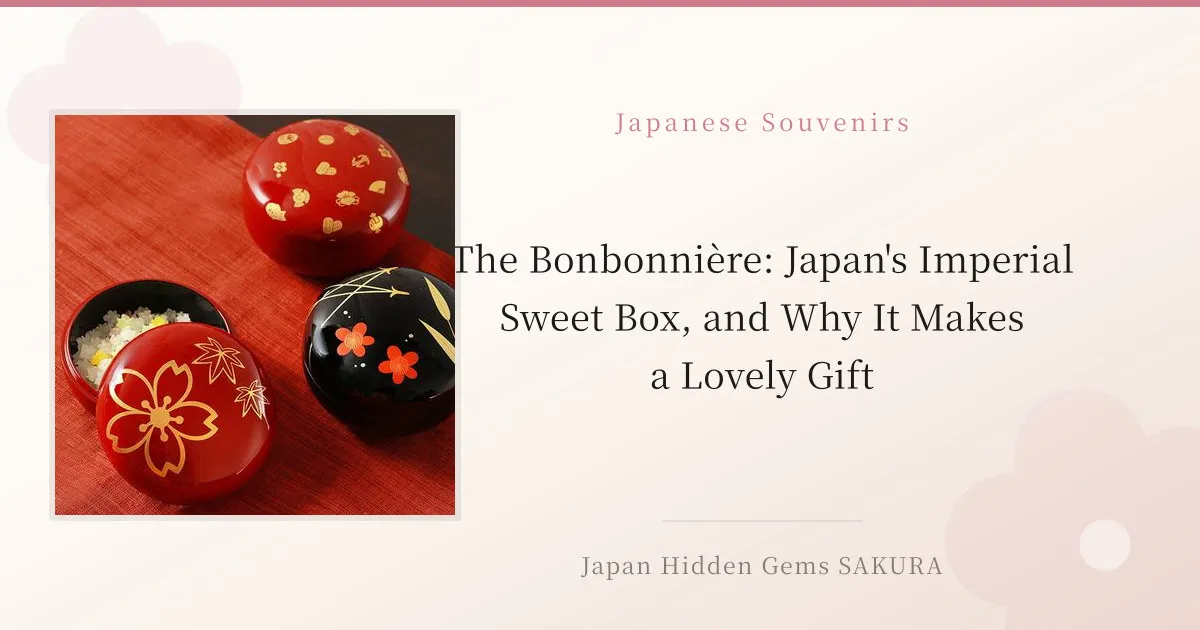
The Bonbonnière: Japan's Imperial Sweet Box, and Why It Makes a Lovely Gift
Some souvenirs are objects. A few are stories that happen to come in a box.
The bonbonnière (ボンボニエール) is the second kind. It is a tiny lidded container, small enough to sit in the palm of your hand, and it holds only a few sweets. It has been part of Japanese Imperial celebrations for more than a century — and almost no visitor to Japan has heard of it.
Where It Came From
The name is French, and so, at first, was the idea.
In the 1890s, as Japan opened to the world, the Imperial Household began hosting Western-style banquets for foreign guests. Such occasions called for a parting gift, and the answer was the bonbonnière: a small, beautiful box of sweets for each guest to carry home.
What began as a borrowed European custom then became thoroughly Japanese. The boxes were made in silver, in porcelain, and in lacquer, and shaped into things with meaning — fans, drums, seashells, chrysanthemums. And they came to be filled not with French bonbons but with konpeitō, the tiny star-shaped sugar crystals that are a Japanese confection in their own right.
Why Konpeitō
This is the part I find quietly moving.
Konpeitō is not made quickly. A single grain of sugar is turned in a heated pan while syrup is added, a little at a time, over many days, until the small star slowly forms its points. There is no way to hurry it.
Because that patient, daily process was felt to resemble the raising of a child, konpeitō became a token of good fortune — and the box that holds it became a vessel in which happiness is said to live.
Still Given Today
Bonbonnières remain part of Imperial celebrations, and they have long since passed into ordinary Japanese life as well. They are given as wedding favours, at milestone celebrations, and as gifts to mark a happy occasion.
If you are looking for a souvenir with more behind it than a keyring, this is a rather perfect one: small, light, unbreakable in a suitcase if lacquered, and carrying a story that takes about a minute to tell.
Where to Find a Good One
The lacquer house Yamada Heiando (山田平安堂), founded in 1919 in Nihonbashi and now based in Daikanyama, is known as a purveyor to the Imperial Household, and also supplies the Ministry of Foreign Affairs and Japanese embassies abroad. Their bonbonnières are finished in traditional auspicious patterns — shunjū (spring and autumn), shōchikubai (pine, bamboo and plum), and takara-zukushi, the “many treasures” motif.
Expect to pay around ¥5,500 for one (at the time of writing).

Yamada Heiando bonbonnière — purveyor to the Imperial Household
View the Yamada Heiando bonbonnière on Rakuten (Japanese site)
Price and stock may change (around ¥5,500 at the time of writing)
Bonbonnières are also made in the other great lacquer traditions of Japan, and one of the easiest to order is a Kishū-nuri pair — lacquerware from Wakayama, here in vermilion and black, decorated with the mizuhiki knot and the “many treasures” motif. A red-and-black pair is a particularly Japanese way to give: the two colours together are considered celebratory, and they are often given to a couple.
Ordering to your hotel. Amazon.co.jp will usually deliver to a Tokyo hotel — enter the hotel’s address with your own name and room number, and do ask the hotel beforehand, as not all of them accept parcels for guests. If the Japanese site is hard going, the language switch sits at the top right of the screen.
One Honest Note
A bonbonnière is small. That is the whole point of it — but it is worth saying plainly, because a photograph online can make it look like a serving bowl. It is a keepsake and a gift, not tableware. If you would like something from the same house that you can genuinely use every day, the Hida Shunkei lacquer bowl is the better answer.
Where This Came From
We first came across the bonbonnière while writing about the New Year greeting at the Imperial Palace — the one morning each January when the palace gates open to everyone. If you are in Tokyo on 2 January, the two go together rather nicely.
Who Is This For?
Anyone who would like to bring home something genuinely Japanese and genuinely small — a gift for someone who appreciates craft, or a keepsake for yourself. It weighs almost nothing, it survives the journey, and it comes with a story about patience and good fortune that most people in Japan know, and almost no one outside it does.
Note: Prices and patterns change, and stock varies. Please check the current listing before ordering.
Affiliate note: This article contains Amazon and Rakuten affiliate links. As an Amazon Associate, we earn from qualifying purchases at no extra cost to you.