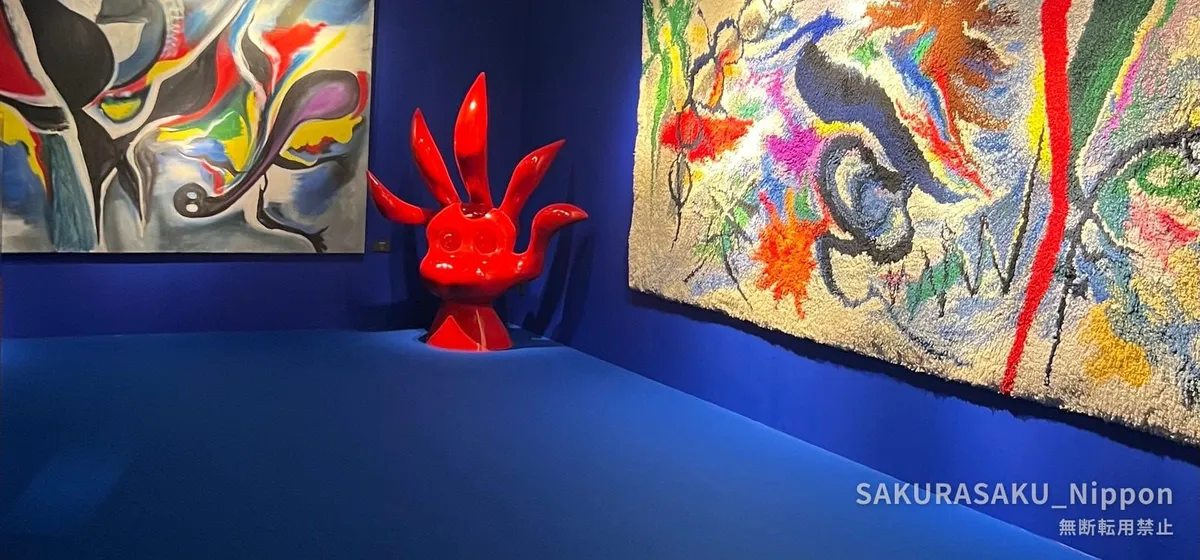
Taro Okamoto Memorial Museum: Art Is an Explosion, One Street Behind Omotesando
Omotesando is a street of flagship stores. Glass, concrete, quiet staff, careful lighting. Then you turn one corner, walk a minute along a smaller road — and there is a low building with block walls and a strange curved roof, half swallowed by plants, with white sculptures leaning out of the garden toward the pavement.
This is the Taro Okamoto Memorial Museum. It was his house.
”Art is an explosion”
Taro Okamoto (1911–1996) is probably the most famous artist in Japan whose name foreign visitors have never heard. If you have seen the Tower of the Sun at Expo ‘70 in Osaka, or the enormous mural Myth of Tomorrow in the passage at Shibuya Station, you have already met his work.
He studied in Paris in the 1930s, came home, and spent the rest of his life arguing — in paint, in bronze, on television — that art should not be beautiful, pleasant or skillful. His most quoted line, “Geijutsu wa bakuhatsu da” (art is an explosion), was so widely repeated on television that it became a national catchphrase.
The House Itself
Okamoto lived and worked here from 1954 until his death in 1996. Before the war, this same address was his family’s home — his parents were the cartoonist Ippei Okamoto and the writer Kanoko Okamoto — and the original house burned down in the bombing of Tokyo.
After the war his friend Junzo Sakakura, a favourite pupil of Le Corbusier, designed the studio that stands here now: walls of stacked concrete block, capped with a convex, lens-shaped roof. At the time it was a famous piece of architecture. Today it feels like a small, stubborn survivor sitting between the luxury boutiques.
The building is not large. You can see all of it in an hour. But almost everything in it was made or thought of in this room.
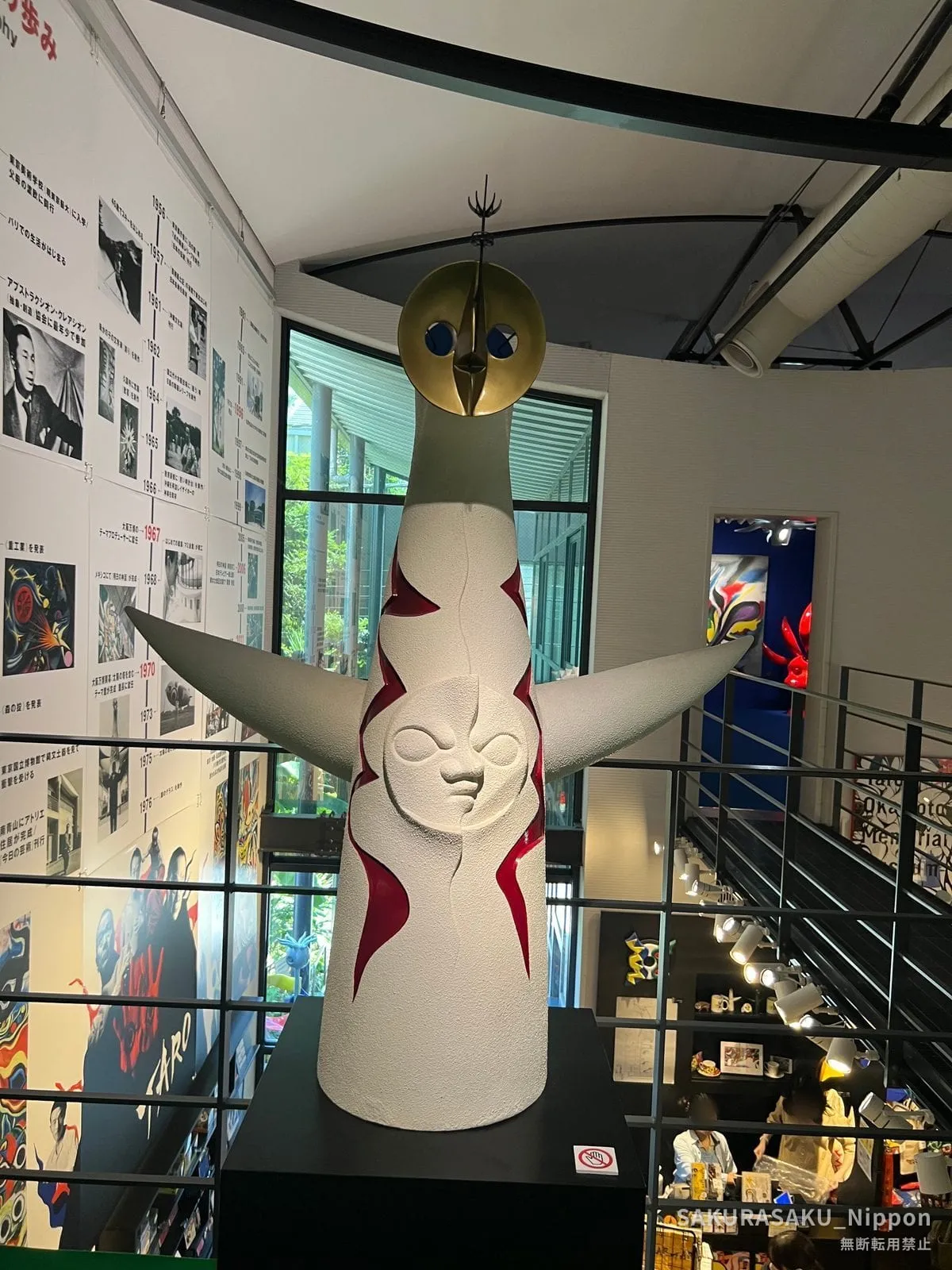
The atelier on the ground floor has been left as it was, with brushes and half-used paint still on the table. Upstairs, the second floor holds changing special exhibitions drawn from the collection.
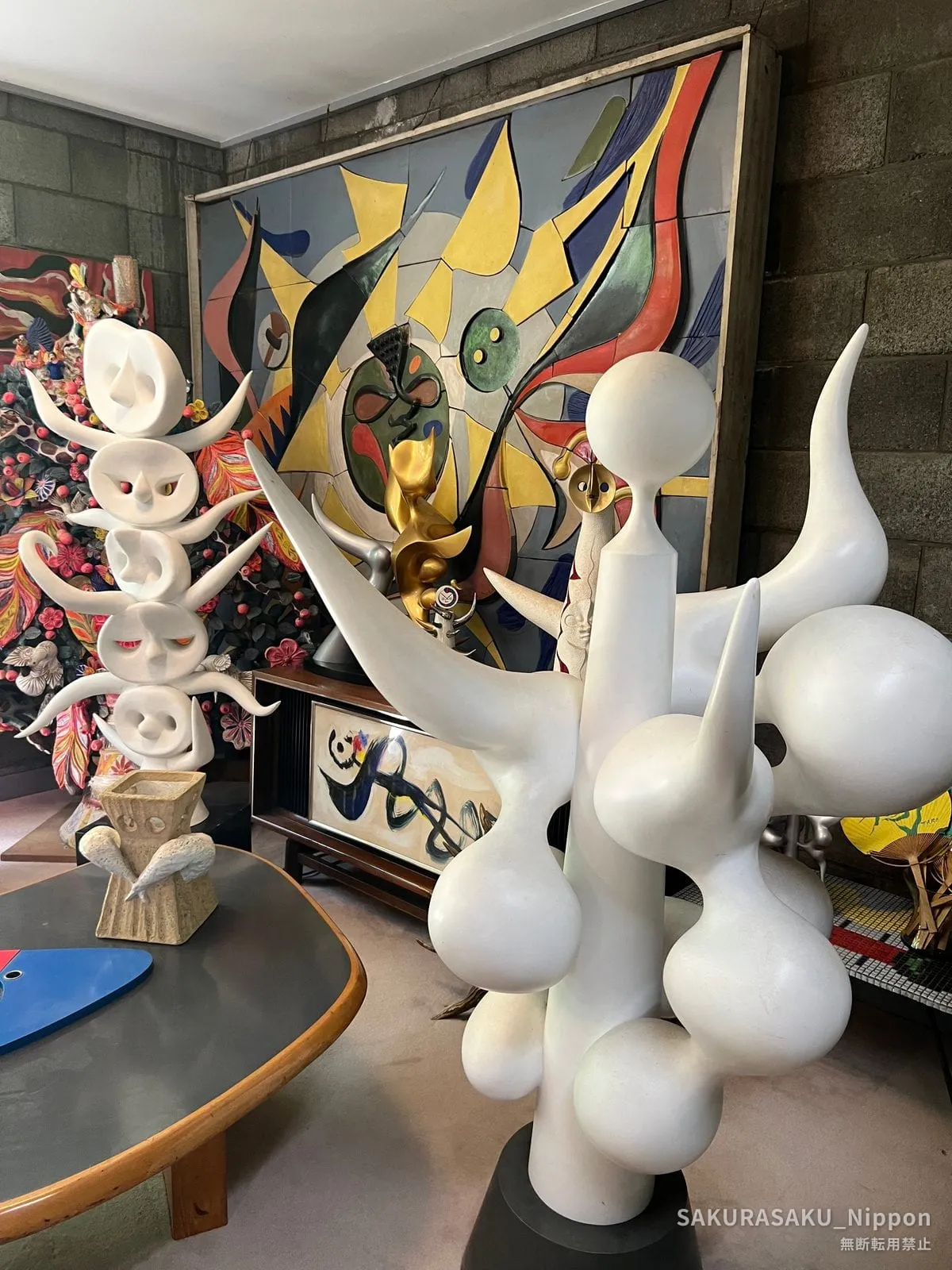
And then there is the garden, where white sculptures stand shoulder to shoulder among the plants like a small crowd waiting for something. It is a genuinely strange place to find behind Omotesando.
Please Read Before You Go
This is a small building that was somebody’s home, and it has some rules that surprise people:
- You take your shoes off. The museum asks visitors to remove their shoes before going in. Wear socks you are happy to be seen in.
- No strollers inside, and there are no lockers or bag storage. Travel light.
- No food or drink may be brought in.
- No parking, for cars or bicycles.
- The building is not step-free and is not equipped for wheelchair access — the museum states this openly.
- Some works carry a “please do not touch” sign. Follow the signage, and keep your voice down: the rooms are small and sound carries.
The Shop Is the Real Surprise
I have been to a lot of museum shops in Tokyo. This one is different, and it is worth budgeting time for.
Most of it does not exist online. When I asked, the staff explained that the official online shop only handles a limited made-to-order range. So the things on these shelves are, in practice, things you can only buy by standing in this building. For a souvenir, that is rare and it matters.
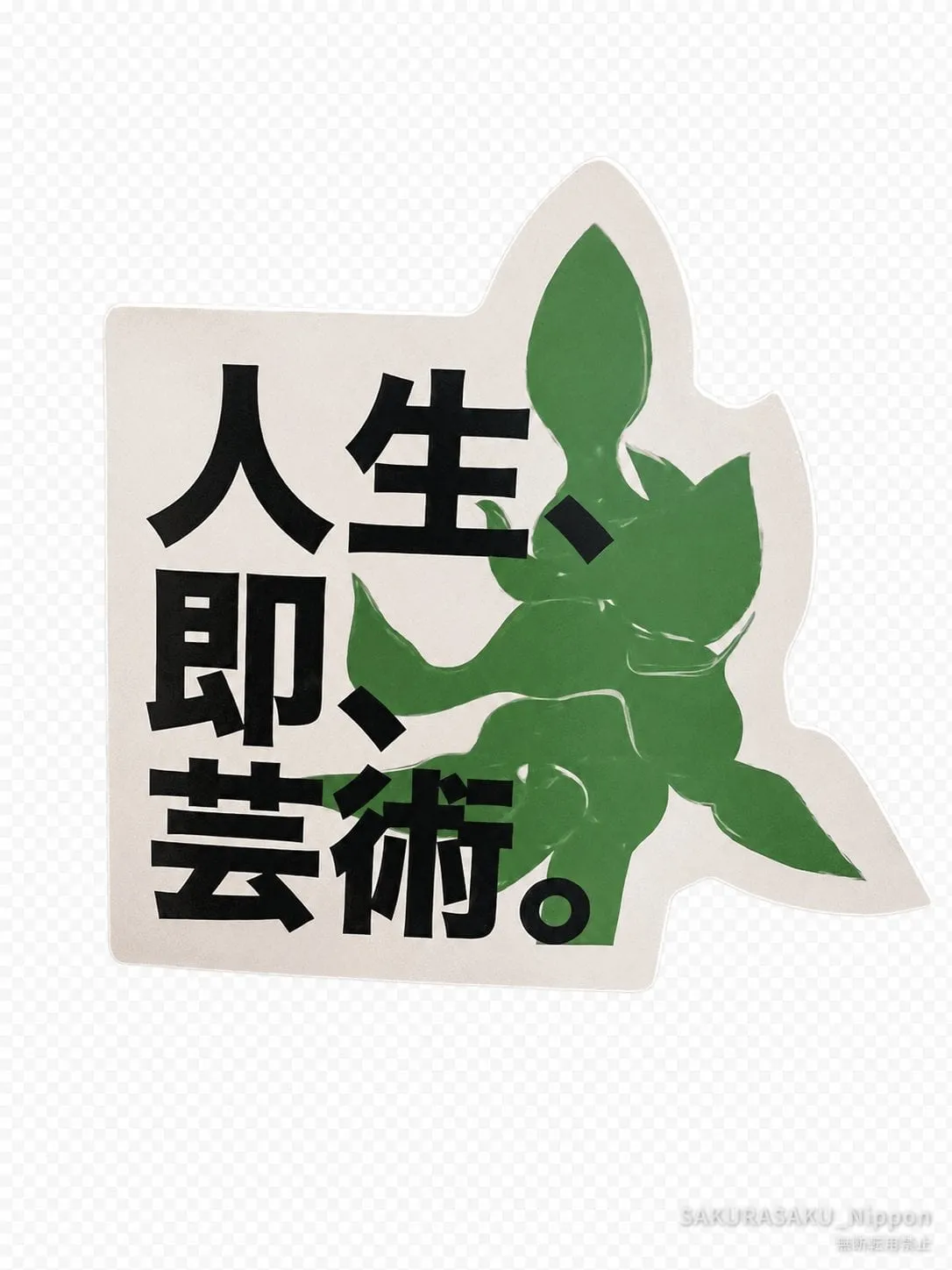
I bought a magnet with “Jinsei, soku, geijutsu.” — “Life is, at once, art” — one of Okamoto’s own phrases, and a handkerchief printed with one of his drawings.
The gachapon in the corner
In one corner of the shop there is a small stack of gachapon (capsule toy machines), and they are not the usual ones. On my visit they held TAROMAN figures — from the cult NHK series that reimagines Okamoto’s sculptures as a 1970s tokusatsu superhero show — at ¥500, and TARO badges at ¥400.
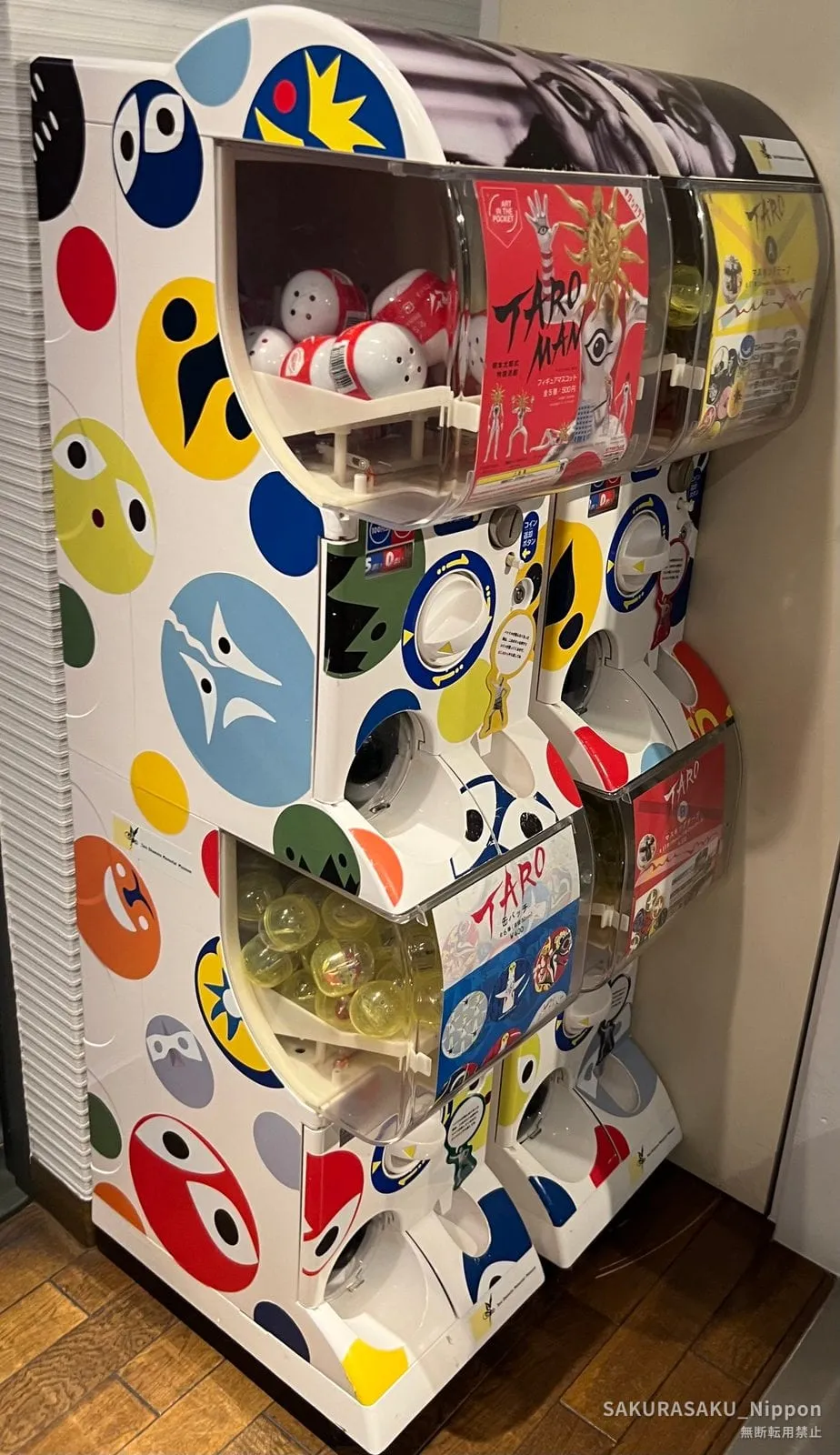
Bring ¥100 coins. Capsule machines here do not take cards or IC. Contents rotate, so what you find may not be what I found.
One Important Warning: There Are Two Taro Okamoto Museums
This trips people up constantly, so please read this before you search for directions.
- Taro Okamoto Memorial Museum (岡本太郎記念館) — the one in this article. Minami-Aoyama, Tokyo. His actual house.
- Taro Okamoto Museum of Art, Kawasaki (川崎市岡本太郎美術館) — a completely separate, much larger city museum in Ikuta Ryokuchi park, in Kawasaki, Kanagawa. About an hour away.
They are different institutions with different websites. And there is a further reason to be careful right now: the Kawasaki museum has suspended exhibitions in its galleries for renovation work, from 30 March 2026 until around the end of March 2029. If you turn up in Kawasaki expecting to see the collection, you will be disappointed.
If you have one afternoon in Tokyo, the Aoyama house is the one to go to.
Practical Info
- Name: Taro Okamoto Memorial Museum (岡本太郎記念館)
- Address: 6-1-19 Minami-Aoyama, Minato-ku, Tokyo 107-0062
- Hours: 10:00–18:00 (last admission 17:30)
- Closed: Tuesdays (open if Tuesday is a national holiday), 28 December – 4 January, and maintenance days
- Admission: Adults ¥900 / high school and university students ¥700 (student ID required) / junior high school age and under free
- Visit time: About 1 hour, plus time in the shop
- Getting there: 8 minutes on foot from Omotesando Station (Ginza, Chiyoda and Hanzomon lines), or 2 minutes from the Minami-Aoyama 6-chome bus stop on Toei bus route 88
Make It an Afternoon
The Nezu Museum is also about eight minutes from Omotesando Station, at the other end of the same quiet stretch of Aoyama. The two make an unusually good pair: an hour of shouting colour in a small house, then a hillside garden and seven centuries of East Asian art. Loud, then quiet.
Taking Okamoto Home
The complete works, with English
If the house makes you curious about the rest of his work, the book to look for is 『岡本藝術』(Okamoto Geijutsu), edited by Akiomi Hirano — who is the director of this museum — and published by Shogakukan Creative in 2015. It gathers around 400 works in chronological order, from his Paris years to the end of his life: paintings, sculpture, magazine covers and product designs.
The useful part for visitors from abroad: the publisher states that work titles and commentary are translated into English and printed alongside the Japanese. A4 format, 208 pages, around ¥3,190 at the time of writing.

『岡本藝術』 — Okamoto Geijutsu: The Work of Taro Okamoto 1911–1996 (Shogakukan Creative)
View Okamoto Geijutsu: The Work of Taro Okamoto on Amazon.jp
View Okamoto Geijutsu: The Work of Taro Okamoto on Rakuten Books (Japanese site)
This one ships outside Japan. Amazon.jp will send it overseas; the international postage is shown at checkout, and your own country may add customs charges.
Price and availability change (¥3,190 at the time of writing)
Amazon Japan can deliver to your hotel in Japan. Order a few days before you fly home and collect it at the front desk — but check with your hotel first that they will accept parcels for guests. Amazon.co.jp switches to English from the control at the top right of the screen.
→ More on this book, including what the English actually covers: The Book the Museum Director Made: 『岡本藝術』
And one thing that packs flatter than you would think
Okamoto also designed a koinobori — the carp streamer flown over Japanese gardens in May. This one is a museum limited edition, three metres long.
Three metres sounds impossible to carry, but a koinobori is thin fabric and is stored folded, so it takes far less room in a case than the size suggests. It is still a collector’s piece rather than a souvenir. It is here mainly because most people never learn that such a thing exists.
One thing to know before anyone takes that seriously: an artist-designed textile like this generally does not qualify for the duty-free “works of art” customs heading, which excludes decorated manufactured articles and craftsmanship of a commercial character even when an artist created the design. It would be assessed as an ordinary textile — so your own country’s import duty and tax would apply on top of the price.

Taro Okamoto koinobori — museum limited edition, 3 m garden size
View the Taro Okamoto koinobori on Rakuten (Japanese-language site)
Price and stock may change (¥4,950,000 including tax, shipping extra, at the time of writing). There is no equivalent listing on Amazon, so Rakuten is the only link.
Who Is This For?
Anyone who has walked Omotesando and quietly wondered whether Tokyo has anything less polished to offer. It costs ¥900 and takes an hour. You will leave with something in your bag that nobody at home can order online, and possibly with a small plastic superhero.
Note: Hours, prices, exhibitions and shop stock change. Please check the official site (taro-okamoto.or.jp) before your visit.
Affiliate disclosure: this article contains affiliate links to Amazon and Rakuten. As an Amazon Associate, this site earns from qualifying purchases. There is no additional cost to you.