Inside Japan's Parliament: The Free Tour of the House of Councillors
Most visitors to Tokyo pass the National Diet Building (国会議事堂) without stopping — a grey, severe silhouette glimpsed from a taxi window.
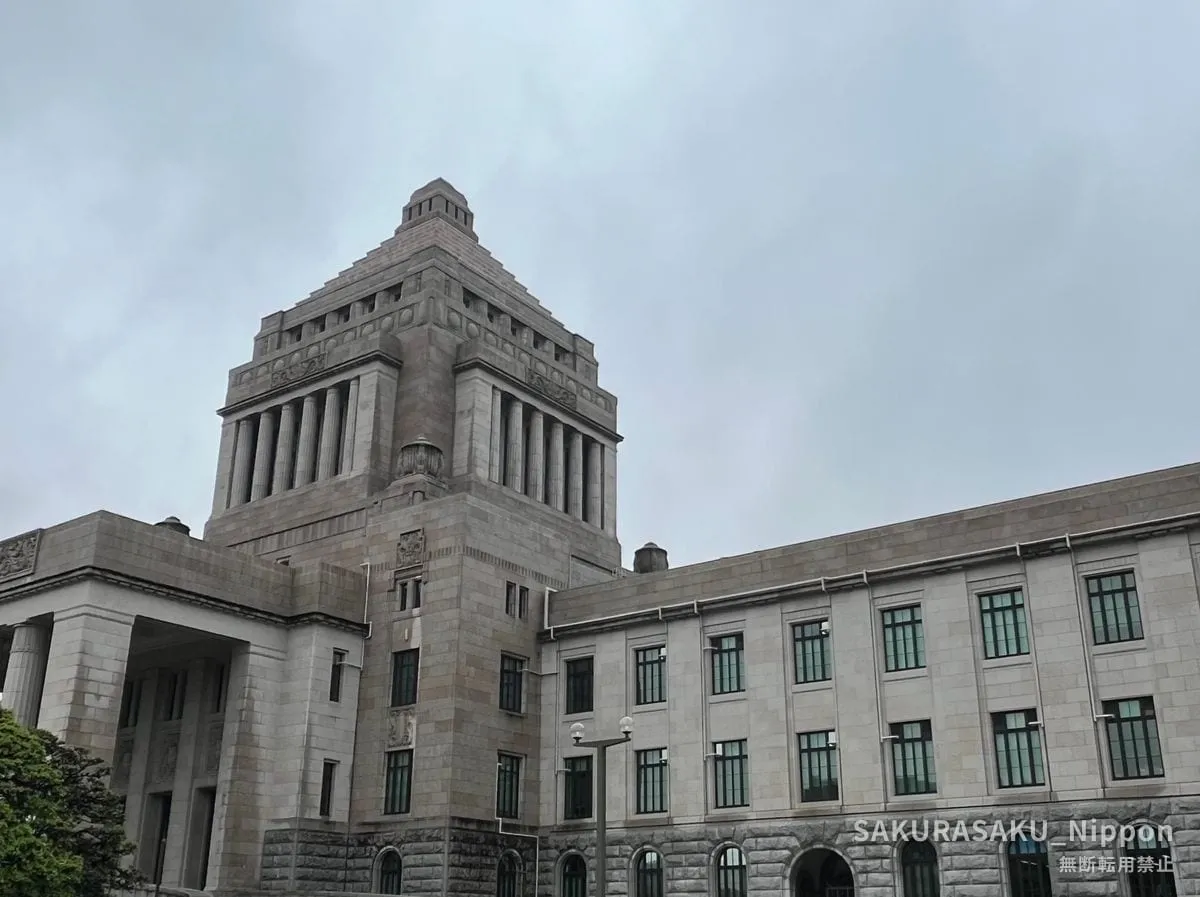
That is a pity, because you may walk inside it, with a guide, entirely free of charge, on almost any weekday. And what waits behind that austere stone front is one of the most lavish interiors in Japan.
A Building Made Almost Entirely of Japan
The Diet Building was completed in 1936, after seventeen years of construction. It was, at the time, the tallest building in the country: the central tower rises about 65 metres, and its stepped, pyramid-like crown is unlike anything else in Tokyo.
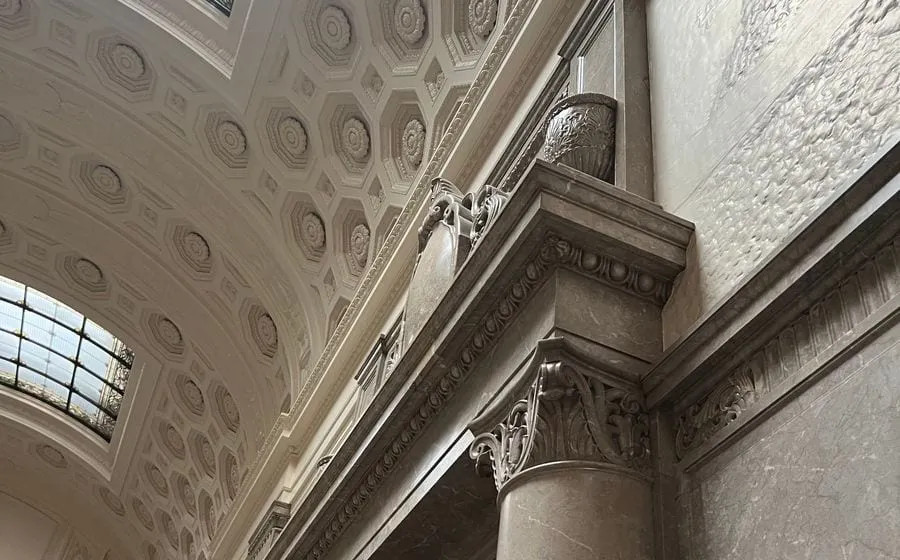
But the detail that says the most about the age is this: the materials are almost entirely Japanese. Around 37 kinds of marble and 24 kinds of timber were gathered from every corner of the country. In an era when a modern public building would ordinarily have been finished with imported European stone, Japan chose to build its parliament out of itself — and the result is a kind of national collection, quietly displayed in the walls, floors and doors.
You notice it most in the corridors: pale marble columns, fossils sometimes visible in the stone, and a stillness that feels far from the traffic outside.
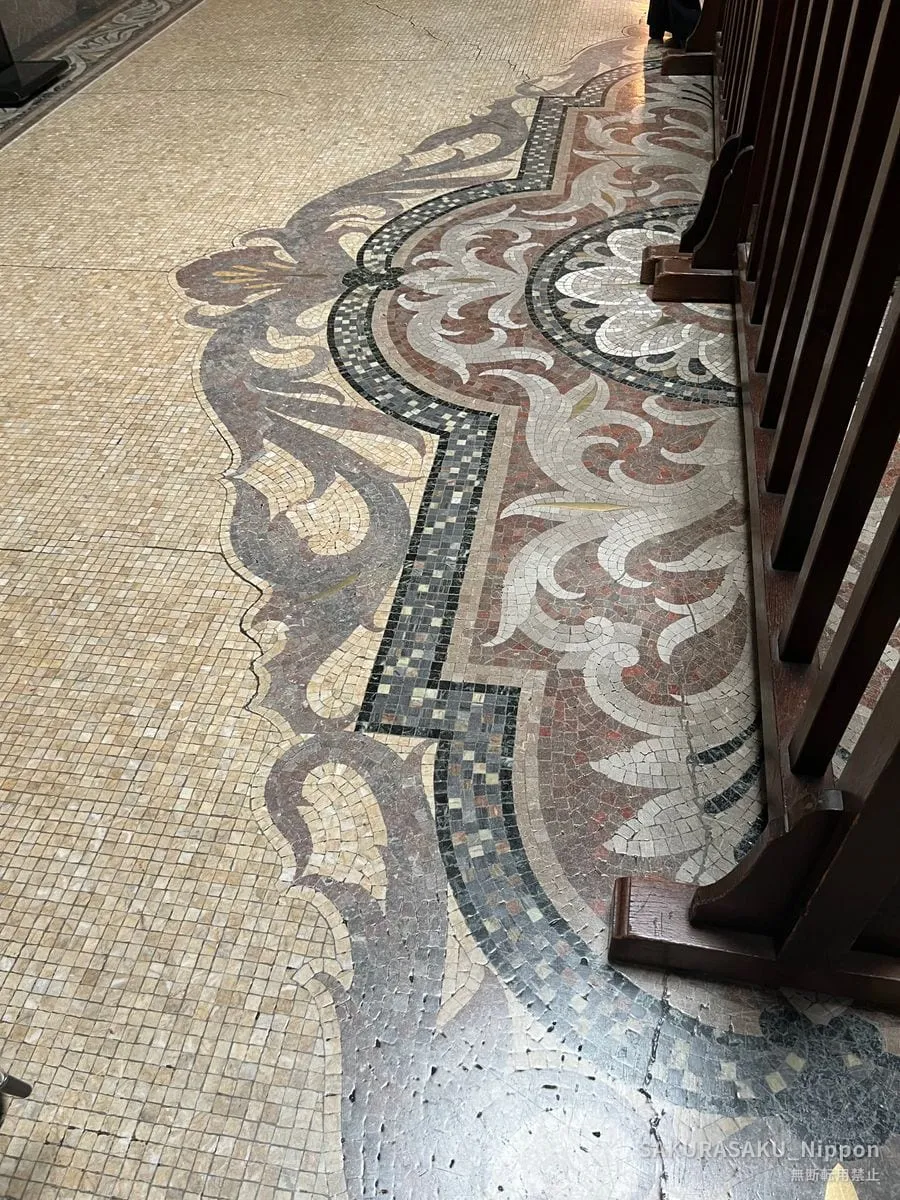
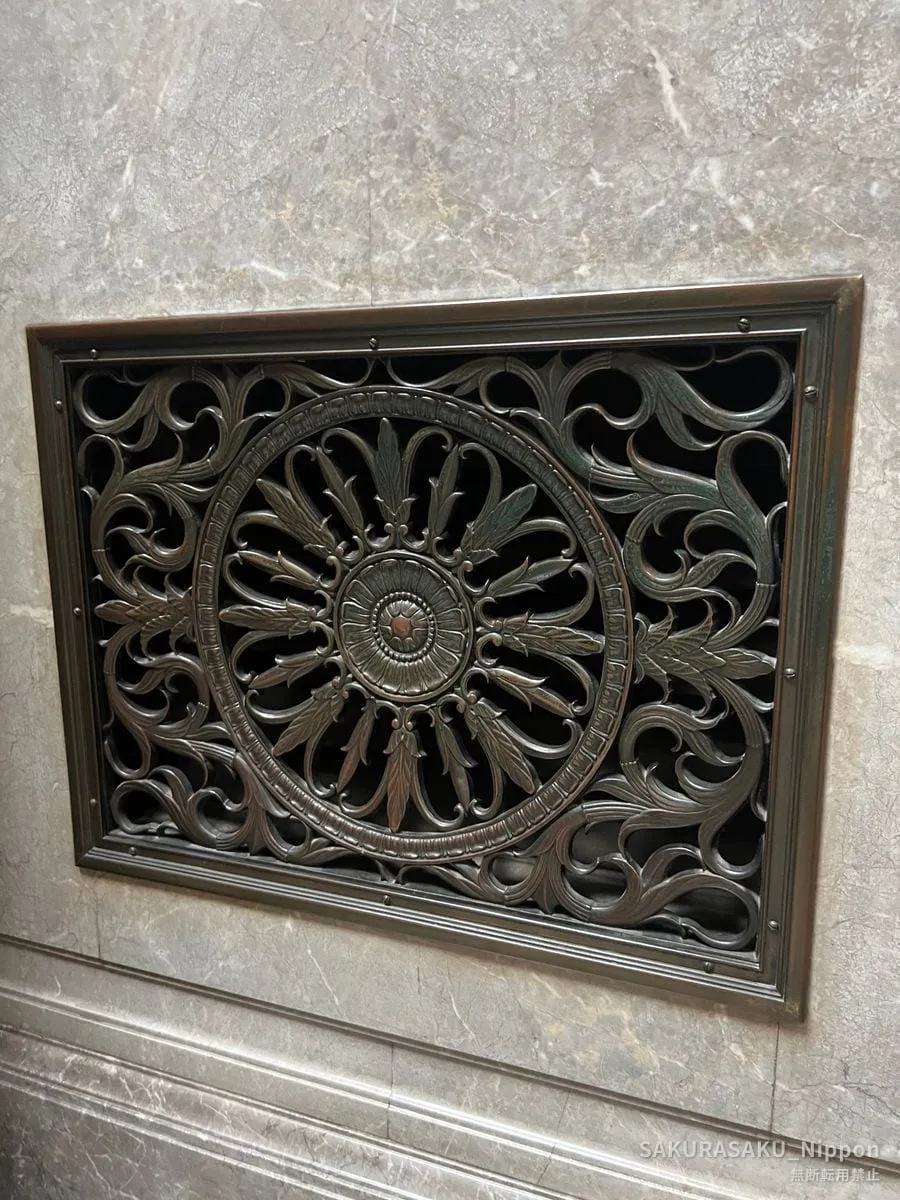
Do look down, and then look at the walls. The floors are laid in mosaic — thousands of small stone pieces forming great curling patterns — and even the ventilation grilles are cast in bronze as flowers and foliage. Nothing here was treated as merely functional.
The Central Hall
Beneath the tower opens the Central Hall, a space of arches, murals and stained glass rising the full height of the building. Around it stand bronze statues of three statesmen of the Meiji era — Itō Hirobumi, Ōkuma Shigenobu and Itagaki Taisuke.
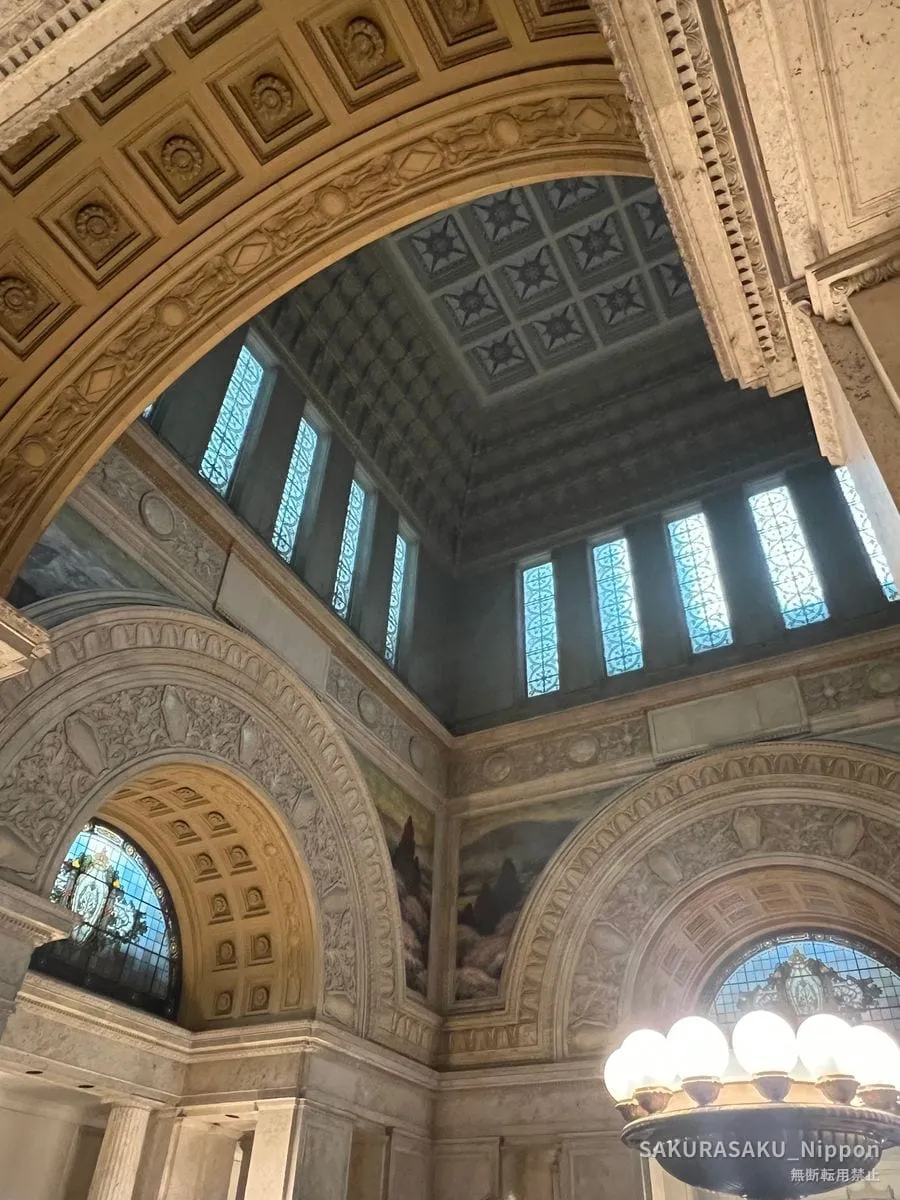
There are four corners, and only three statues. Guides like to mention that the fourth pedestal was left empty — a small mystery with several explanations, the most charming being that politics is never finished, and the place is reserved for someone yet to come.
The Chamber of the House of Councillors
The tour’s quiet climax is the chamber itself, seen from the public gallery above. It is a room of dark polished wood, deep red carpet, and — best of all — a ceiling entirely of stained glass, patterned with flowing arabesques, filling the room with soft daylight from three storeys up.
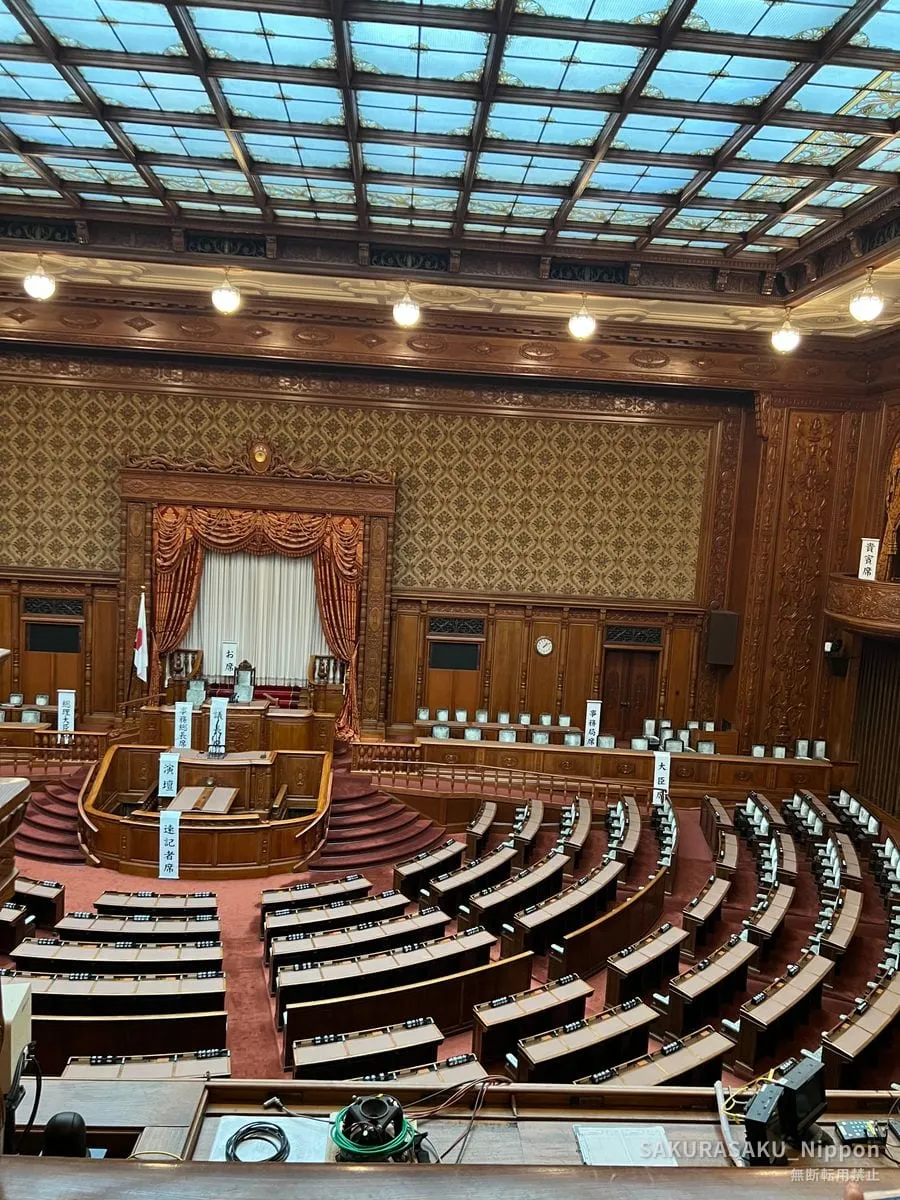
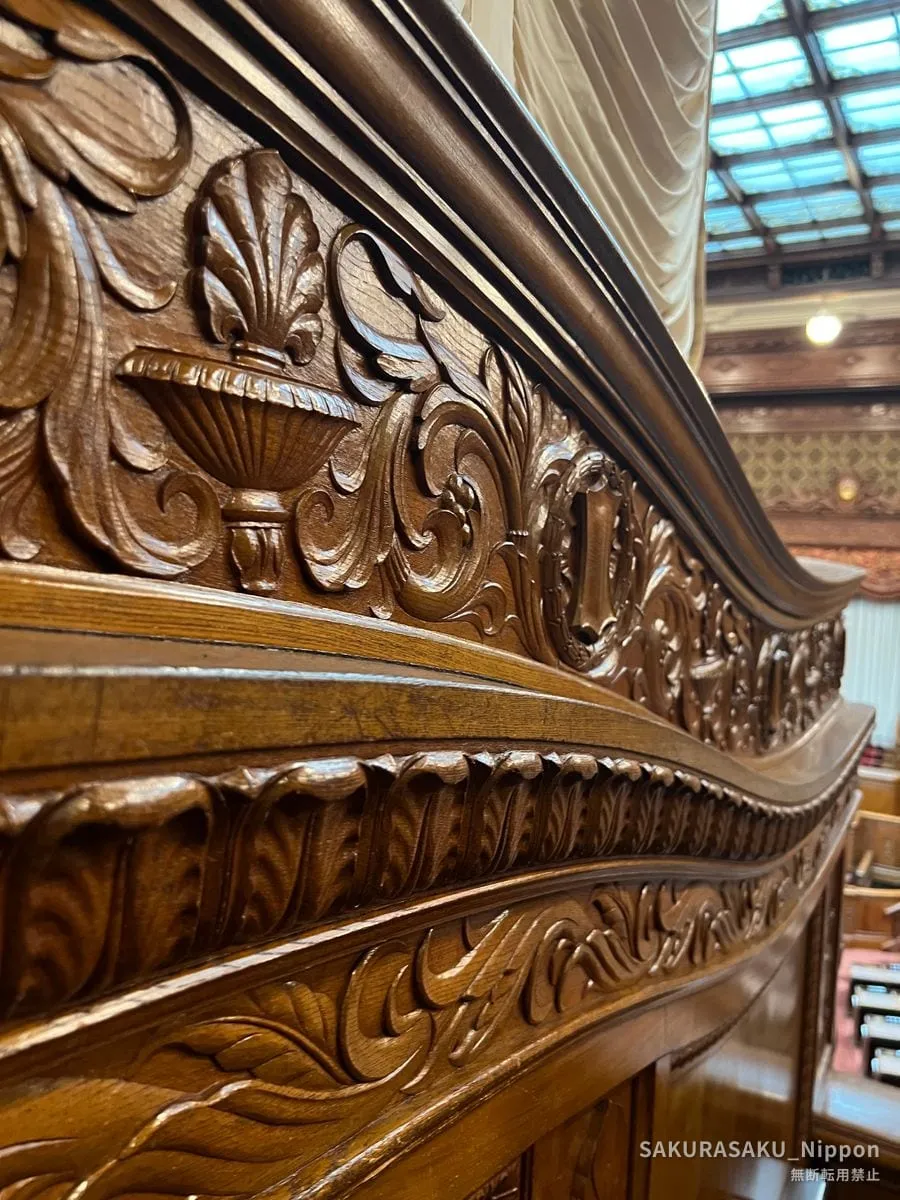
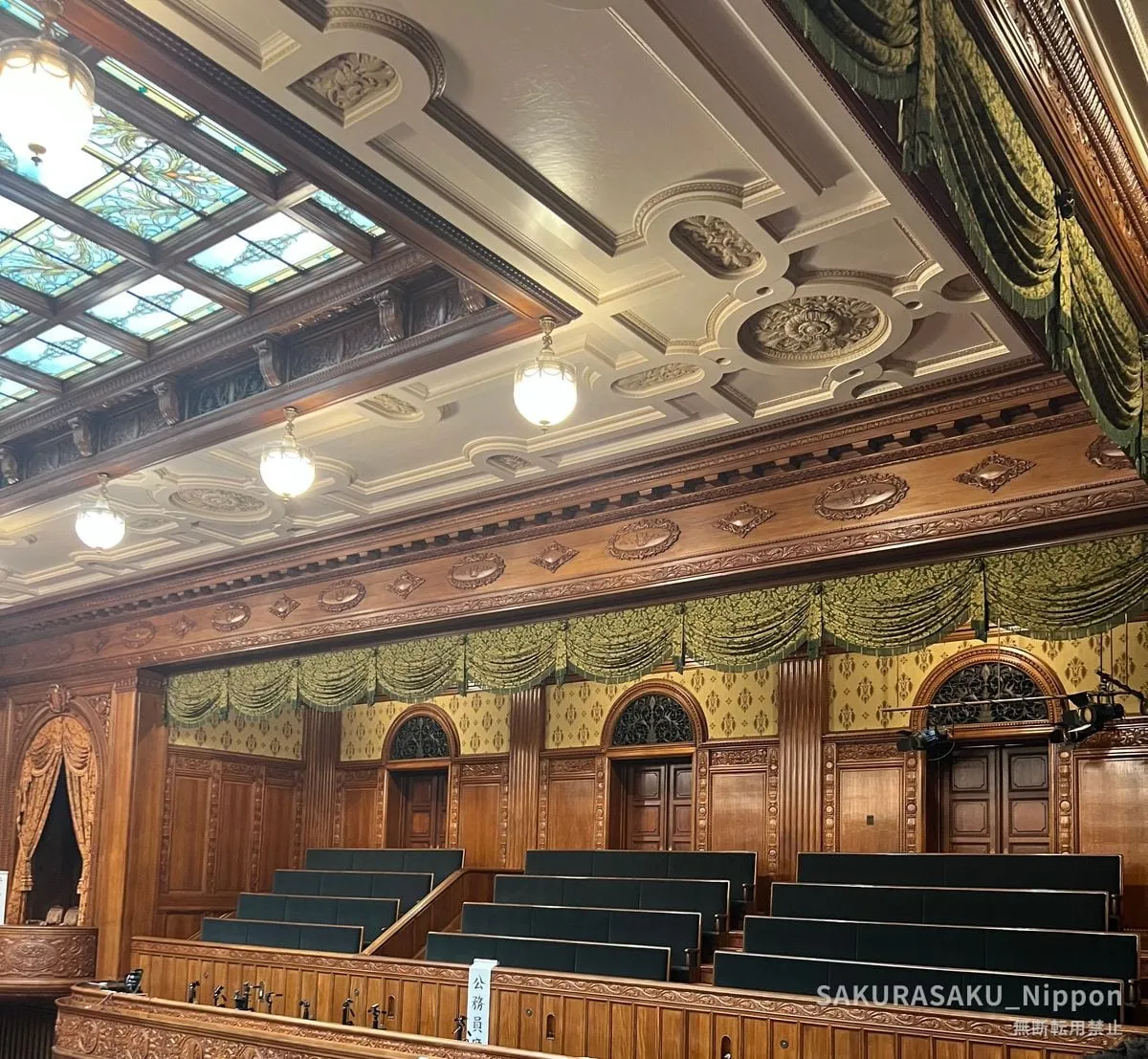
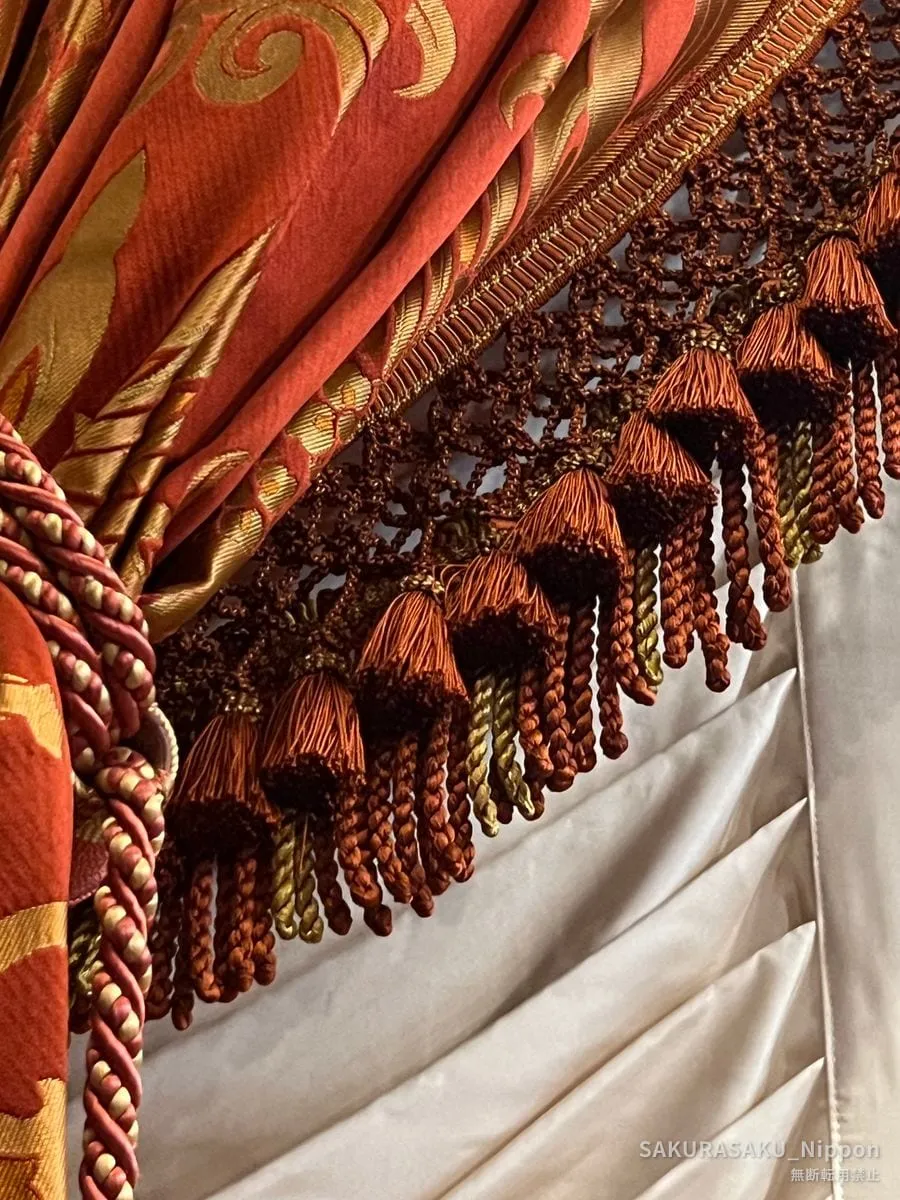
Then, if you have a moment, look closely at the details. The balustrade in front of you is hand-carved in leaves, shells and ribbons; the curtains are woven with gold and finished with heavy tassels; the walls above are hung in green and framed with plasterwork. It is craftsmanship of a kind that would be almost impossible to commission today.
The Emperor’s Chair
One object stops almost everyone. In a glass case stands a gilded chair upholstered in crimson, carved with lions and phoenixes and bearing the golden chrysanthemum crest.
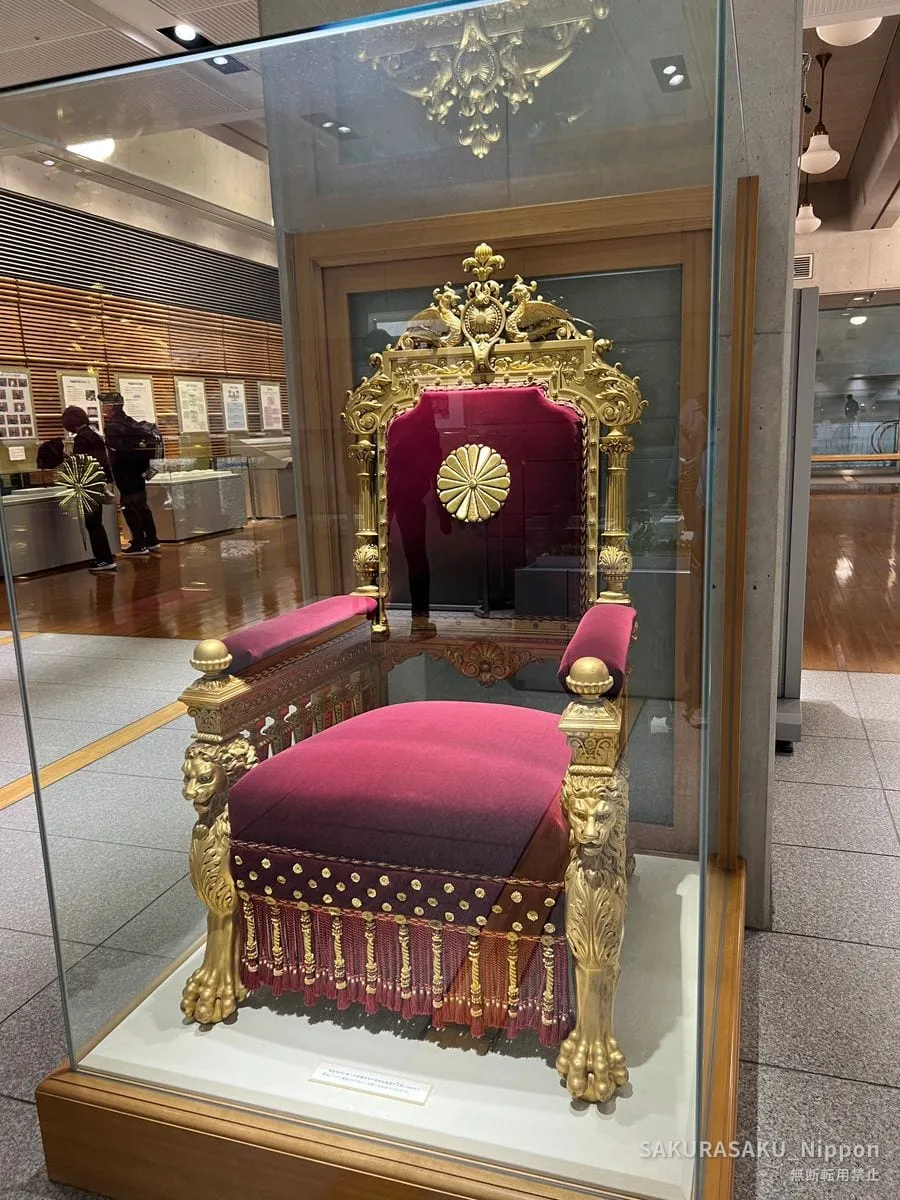
The House of Councillors is where the opening ceremony of the Diet is held, and where the Emperor is present. A seat is therefore set at the centre front of the chamber — and this chair, from the earlier era of the building, survives as a reminder of that ceremony. It is a startling piece of Meiji-Taishō craftsmanship, and quite unlike anything else on the tour.
How to Join the Free Tour
This is the part worth reading carefully, because the procedure is simple but strict.
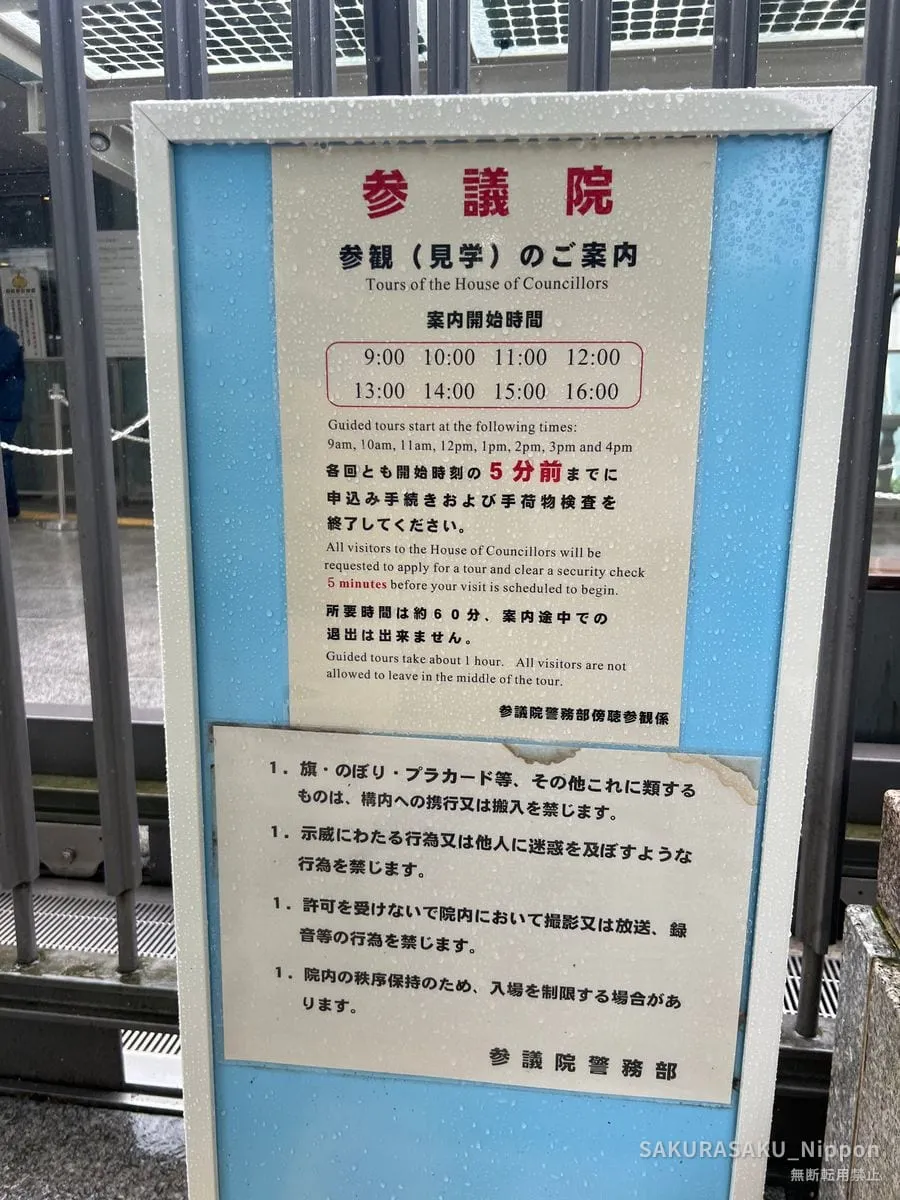
- It is free, and it lasts about 60 minutes. Once the tour begins you cannot leave partway through, so please visit the toilet and settle everything beforehand.
- There are eight tours a day, starting on the hour: 9, 10, 11, 12, 1, 2, 3 and 4 o’clock. For a small party there is no advance booking — but you must fill in the application form on the day, at the reception, and complete the security check by five minutes before your tour starts. Arriving fifteen minutes early is comfortable; arriving at the hour is too late.
- Bring photo identification. For overseas visitors, please carry your passport.
- The House of Representatives is a separate tour, with its own reception and its own application. If you would like to see both, plan them as two separate visits.
A few more practical notes: tours run on weekdays (they are not held on public holidays or over the New Year), and a group of ten or more must reserve in advance. Photography is permitted at certain points only — your guide will tell you where, and it is important to follow that instruction exactly.
Do Not Bring a Suitcase
This is worth planning around, particularly if you are visiting on a moving day.
Everyone passes through a security check with a metal detector, a small rucksack is fine, and then you walk for sixty minutes without being able to leave partway through. A suitcase makes all three of those awkward, and there is no cloakroom for visitors.
Kokkai-gijidōmae Station does have coin lockers, including large ones that take a suitcase — but there are only so many of them, and on a busy morning you may arrive to find every one occupied. That is a poor discovery to make fifteen minutes before your tour.
If your day involves luggage — checking out of one hotel before checking into the next, or heading to the airport afterwards — it is worth booking a left-luggage spot in advance rather than trusting to the lockers. Radical Storage works with shops, cafés and hotels around Tokyo: you book a place near the station beforehand, drop the bag, and collect it later at a flat daily rate per item.
Book luggage storage near the station in advance
Find a drop-off point on Radical Storage →If you are travelling with only a day bag, none of this applies — simply walk in.
Practical Information
- Name: The National Diet Building — House of Councillors tour (参議院参観)
- Cost: Free
- Duration: About 60 minutes, no leaving partway through
- Times: Eight tours daily, on the hour from 9:00 to 16:00 (weekdays)
- Booking: Not required for small parties — apply in person on the day; 10 or more must book ahead
- Bring: Photo ID (passport for overseas visitors)
- Reception: At the House of Councillors Annex (参議院別館); follow the signs to 参観受付
- Nearest stations: Kokkai-gijidōmae (Marunouchi and Chiyoda lines) or Nagatachō (Yūrakuchō, Hanzōmon and Namboku lines)
Who Is This For?
Anyone who enjoys architecture, craftsmanship, or the quiet pleasure of standing somewhere that decisions are actually made. It costs nothing, takes an hour, and sits within a short walk of Akasaka and Kasumigaseki — an easy and genuinely memorable addition to a Tokyo morning.
Note: Tour times, days and procedures may change, particularly when the Diet is in session. Please check the official House of Councillors website before you go.
Affiliate note: This article contains an affiliate link. If you book through it, we earn a small commission at no extra cost to you.