Wet Paint, in Eighteen Languages: Japan and Its Notices
Japan is a country of notices. You will have noticed this within a day of arriving: signs on the platform edge, signs on the escalator, signs on the door of the train, signs asking you not to walk while looking at your phone, signs thanking you in advance for something you have not yet done.
Most of them are in the places you would expect — stations, temples, department stores, anywhere with visitors. What I found the other week was in none of those places. It was on an ordinary residential back street in Tokyo, of the kind no tourist has any reason to walk down.
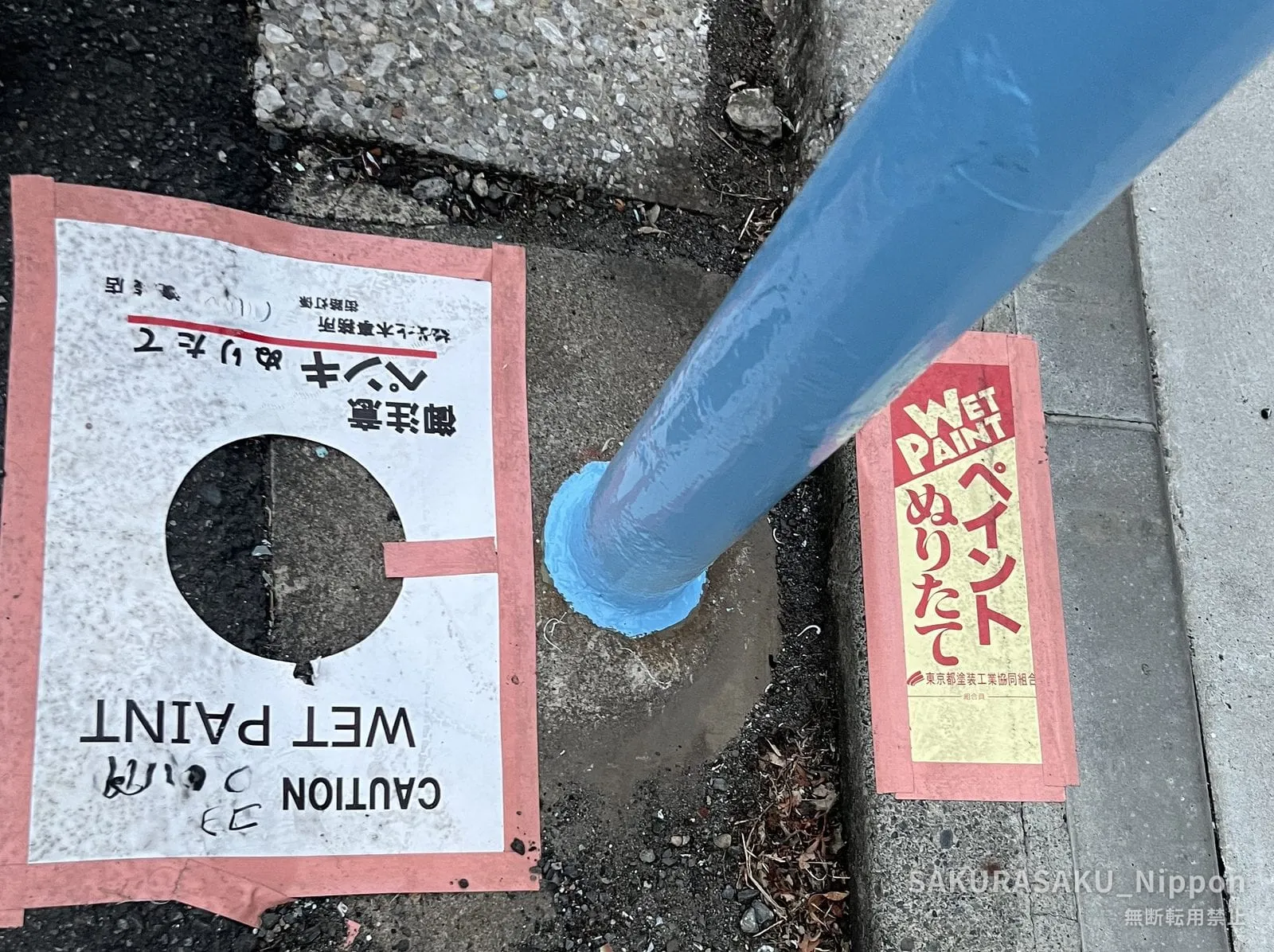
Someone had repainted a guardrail post a bright, cheerful blue. And beside it, taped flat to the tarmac with pink tape, were two signs.
The Ordinary One
The tag on the kerb is the standard article: red and gold, “WET PAINT” above “ペイントぬりたて”, issued by the Tokyo Painting Industry Cooperative Association and carried by its member firms. Every painter in the city has a roll of them. Two languages, mass-produced, entirely sufficient.
That one is not the interesting sign.
The Other One
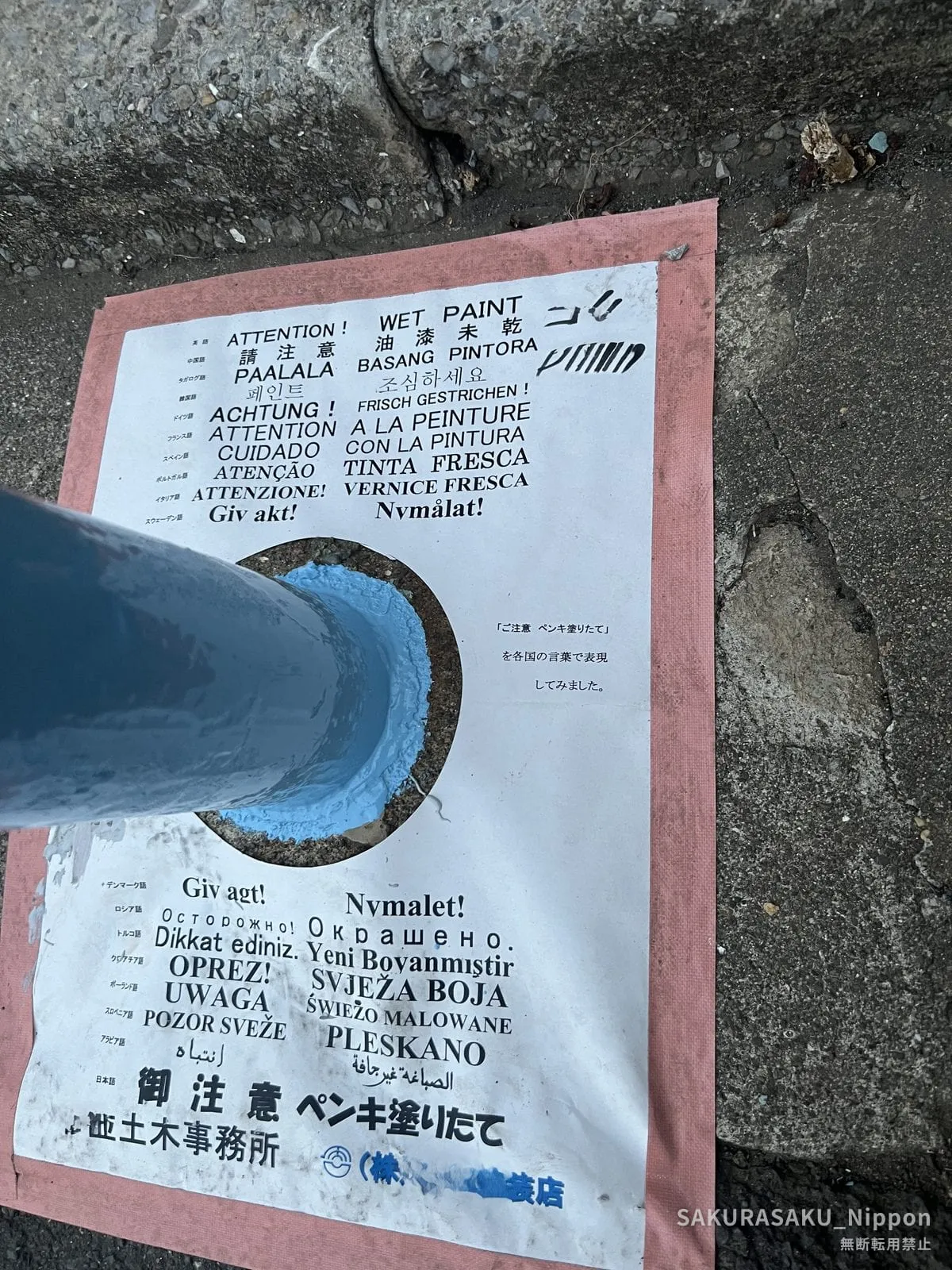
The other was printed on an office printer and taped down with the same pink tape. It gives the same message — caution, wet paint — in eighteen languages.
| English | ATTENTION! WET PAINT |
| Chinese | 請注意 油漆未乾 |
| Tagalog | PAALALA BASANG PINTORA |
| Korean | 페인트 조심하세요 |
| German | ACHTUNG! FRISCH GESTRICHEN! |
| French | ATTENTION À LA PEINTURE |
| Spanish | CUIDADO CON LA PINTURA |
| Portuguese | ATENÇÃO TINTA FRESCA |
| Italian | ATTENZIONE! VERNICE FRESCA |
| Swedish | Giv akt! Nymålat! |
| Danish | Giv agt! Nymalet! |
| Russian | ОСТОРОЖНО! Окрашено. |
| Turkish | Dikkat ediniz. Yeni boyanmıştır |
| Croatian | OPREZ! SVJEŽA BOJA |
| Polish | UWAGA Świeżo malowane |
| Slovenian | POZOR SVEŽE PLESKANO |
| Arabic | انتباه الصباغة غير جافة |
| Japanese | 御注意 ペンキ塗りたて |
Someone has also added a line by hand at the top corner, in a script that is not on the printed list — a nineteenth, presumably, added by whoever felt it was missing.
And in the middle of the sheet, in small type beside the hole cut out for the post, there is a sentence that gives the whole thing away:
「ご注意 ペンキ塗りたて」を各国の言葉で表現してみました。
We tried expressing “Caution: Wet Paint” in the languages of various countries.
We tried. Not “as required by regulation”. Not “in accordance with guidance”. Somebody at a small civil-engineering office sat down and made this, and the tone of that sentence is closer to a school project than to a public notice.
What Makes It Worth Stopping For
Nobody asked for this sheet. The union tag was already there, and it was already enough. No inspector was going to check whether the Slovenian was present.
And look at the list. Croatian and Slovenian, on a back street in west Tokyo. Danish and Swedish, separately, when the two lines are nearly identical. Tagalog high up near the top, ahead of German and French — which, if you know who actually lives and works in these neighbourhoods, is the one choice on the sheet that is clearly based on real observation rather than a list of world languages.
The person who made it was not modelling their audience. They were trying to make sure that nobody — anybody at all — got paint on their clothes. It is over-engineered in a way that is difficult not to find touching.
Why Japan Has So Many Signs
This one is unusual in its execution but not in its instinct. A few things are going on at once.
Avoiding 迷惑. The organising idea of Japanese public behaviour is meiwaku — trouble caused to other people. Ruining a stranger’s coat is a small thing, but it is squarely in that category, and the effort you see here is aimed at preventing it rather than at avoiding liability for it.
Notices as apology. Read the wording on Japanese construction hoardings and you will find that a surprising number of them apologise. We are sorry for the inconvenience. Thank you for your cooperation. The sign is doing social work, not just informational work.
Small firms with a great deal of pride. The sheet carries the name of a local civil-engineering office and, in the corner, a painting firm’s name — half of it covered by a splash of the very paint the sign is warning about, which is the most honest thing in the photograph.
And an Honest Counterpoint
It would be easy to tell only the warm version of this story, so here is the other half.
Japan’s density of notices has a cost. When everything carries a warning, warnings stop registering — you learn to walk past them, which is exactly what you should not do at a level crossing or a construction site. Some notices exist mainly so that responsibility has been transferred should something happen. And a small but growing number of signs in busy neighbourhoods are aimed specifically at foreign visitors in a tone considerably cooler than this one: do not eat while walking, do not enter, this is a private road.
Those signs are also worth reading, and worth obeying. They tend to appear where the number of visitors has begun to outstrip what an ordinary residential street can absorb.
Notices Worth Being Able to Read
If you learn to recognise a handful of these, Japan becomes noticeably easier to move around.
| Sign | Meaning |
|---|---|
| 立入禁止 | No entry |
| 私有地 | Private land |
| 通り抜けできません | No through access |
| 足元注意 | Watch your step |
| 頭上注意 | Mind your head |
| 撮影禁止 | No photography |
| 関係者以外立入禁止 | Staff only |
| ペンキ塗りたて | Wet paint |
Please Don’t Go Looking For It
I have deliberately not said which street this was on, and there is no map on this page. It is somebody’s residential neighbourhood — houses, a school run, people who have not agreed to be a destination. The sign will be gone by now anyway; the paint dried within the day.
The point is not this particular post. It is that this kind of thing is everywhere in Japan, on streets no guidebook covers, and that you will only ever see it if you are looking down at the pavement instead of up at the landmark. Walk a residential street quietly, keep your camera pointed at the road rather than into windows, and you will find your own.
A Postscript, for People Who Liked the Workers More Than the Sign
If what stayed with you from this is the crew — the small firm, the pink tape, the care taken over a job nobody was watching — Japan makes a plastic model kit of exactly those people. Four figures resurfacing a road: a young woman with a rake, a man on a plate compactor, a veteran with a shovel, and a man with a wheelbarrow.

Hasegawa 1/35 Construction Workers Set A, WM03
View Hasegawa Construction Workers Set A on Amazon.jp
View Hasegawa Construction Workers Set A on Rakuten (Japanese site)
Price and stock may change (¥1,400 before tax / ¥1,540 including tax at the time of writing)
It is unpainted and needs building, and the glue is not in the box — I have written about what you actually get, and what you have to buy at home separately.
Note: The translations in the table are transcribed from the sign as it was printed, including its own inconsistencies.
Affiliate note: This article contains Amazon and Rakuten affiliate links. As an Amazon Associate, we earn from qualifying purchases at no extra cost to you.